The first subcontractor can file a mechanics lien against the property, creating pressure that makes it nearly impossible for the owner to sell or refinance until the debt is resolved. The second can't lien government property at all. Their only route is a claim against the project's payment bond.
These two tools — mechanics liens and construction bonds — aren't interchangeable. They're designed for different situations, but they also interact in ways most contractors don't fully understand until they're already in trouble. Miss a deadline on either one and the right to payment disappears permanently.
This article covers how each tool works, where they overlap, how a lien can be "bonded off," and what contractors need to know about deadlines, public versus private projects, and keeping licensing current.
Key Takeaways
- Mechanics liens apply to private projects — they create a security interest in the property that forces payment resolution
- Payment bonds substitute for liens on public projects, where government property cannot be liened
- Contractors can "bond off" a lien, shifting the claim from the property title to a surety bond
- Missing filing deadlines for a lien or bond claim permanently forfeits the right to collect
- An active contractor's license bond is required in many states to preserve lien rights and collection remedies
What Is a Mechanics Lien and How Does It Protect Contractors?
A mechanics lien is a statutory security interest attached to real property. As California CSLB explains, contractors, subcontractors, laborers, and material suppliers can file a mechanics lien if they go unpaid for work or materials provided to improve that property.
The leverage comes from what it does to the title. According to Levelset's legal-team fact-checked guide, a recorded mechanics lien clouds real estate title and makes a sale or refinancing extremely difficult until the lien is resolved. That pressure is what gives the lien its practical power — it forces the owner to deal with the payment dispute rather than ignore it.
Who Can File — and Who Can't
Lien eligibility varies by state, but generally includes:
- General contractors and direct subcontractors
- Material suppliers and equipment lessors
- Laborers and some design professionals
Tier rules matter. Pennsylvania's Mechanics' Lien Law, for example, excludes parties contracting with a materialman or a subcontractor not in direct privity with the contractor, cutting off some lower-tier claims. Most states protect first- and second-tier subcontractors, but rights thin out further down the chain.
Tier standing isn't the only filter. Licensing requirements work as a separate hard barrier to lien rights in many states:
- California: Business and Professions Code Section 7031 bars unlicensed contractors from any action for compensation and makes certain security interests unenforceable — active license status requires a $25,000 contractor license bond
- Washington: Registration is required before a contractor may sue for compensation; registration is automatically suspended if the required $30,000 bond (general) or $15,000 bond (specialty) lapses or is impaired
Letting either requirement lapse can eliminate lien rights entirely.
What Disqualifies a Lien?
Not every unpaid contractor qualifies. Common disqualifiers include:
- Working on public (government-owned) property
- Unlicensed status where licensing is required
- Materials not incorporated into the improvement
- Work performed for purely public purposes (Pennsylvania explicitly excludes this)
- Lower-tier status below the cutoff in the applicable state
What Information Is Needed to File a Mechanics Lien?
Core requirements across most states include:
- Claimant's name and contact information
- Property description and owner's name
- Description of the unpaid labor or materials
- Last date work was performed or materials supplied
- Amount claimed, after any credits
- Proof of service on the property owner
State requirements add wrinkles: California Civil Code Section 8416 requires the name of the person who hired the claimant, while Washington mandates both first and last furnishing dates. Always use the form specific to the state where the project is located.
What Are Construction Bonds and How Do They Work?
A surety bond is a three-party contract. The principal (the contractor) makes a guarantee to the obligee (the project owner or government agency), backed by the surety (the bonding company). If the principal fails to perform, the surety steps in.
NASBP identifies four main bond types relevant to construction:
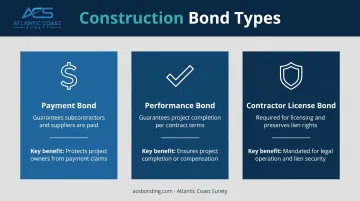
- Payment bonds guarantee that subcontractors, suppliers, and laborers will be paid. If the general contractor fails to pay, these parties file a claim against the bond rather than pursuing a lien or litigation.
- Performance bonds guarantee the contractor will complete the project according to contract terms. If the contractor defaults, the surety can finance completion, hire a replacement contractor, or compensate the owner directly. This is a separate protection from the payment bond.
- Contractor license bonds are required in most states as part of the licensing process. Keeping this bond active preserves the contractor's licensed status, along with their lien rights and legal ability to collect payment in court.
The Miller Act and Little Miller Acts
The federal Miller Act (40 U.S.C. § 3131) requires performance and payment bonds on federal public construction contracts. The statutory threshold is $100,000, though FAR 28.102-1 currently applies to contracts exceeding $150,000, with alternative payment protection required for contracts between $35,000 and $150,000.
Every state has a parallel "Little Miller Act" for state-funded projects. Bond thresholds vary significantly:
| State | Payment Bond Trigger |
|---|---|
| California | Public works contracts over $25,000 |
| Texas | Payment bond over $25,000; performance bond over $100,000 |
| Virginia | Nontransportation public construction over $500,000 |
| North Carolina | Projects over $300,000 generally |
For contractors working on federally funded projects, the surety backing a bond must appear on the U.S. Treasury's Circular 570 — the T-listed designation. A bond backed by a non-T-listed carrier won't be accepted.
Atlantic Coast Surety works exclusively with A-rated and T-listed providers, which matters directly for contractors bidding on federal and state public work. Their in-house underwriting authority also allows them to move on submissions without routing everything through a carrier's own underwriting department, which counts when project deadlines are tight.
How Liens and Bonds Work Together to Protect Contractor Payments
Liens and bonds address the same core problem — unpaid contractors — but they operate through different mechanisms depending on the project type. Understanding how they interact is what determines which remedy you can actually use.
On private projects, a contractor's primary protection is the mechanics lien. But if a payment bond is also in place (required by the owner or lender), subcontractors and suppliers have a direct claim against the bond, reducing the incentive to lien the property at all.
On public projects, liens are off the table entirely. The payment bond is the substitute remedy — unpaid subcontractors and suppliers pursue the bond, not the property.
On private projects with statutory payment bonds (Florida is the clearest example), the bond can legally exempt the property owner from liens when it's filed with the required notice of commencement. Claimants look to the bond, not the title.
Underlying all three scenarios is the contractor's license bond. Without an active license bond where required, a contractor loses their license — and with it, the ability to file a lien, pursue a bond claim, or enforce any payment remedy in court. All three bond types must stay current for these protections to hold.
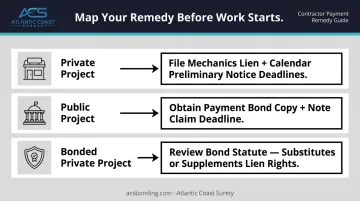
Before work starts, classify every project by type and map your remedies accordingly:
- Private jobs — Preserve lien rights and calendar all preliminary notice deadlines
- Public jobs — Obtain a copy of the payment bond immediately and note the claim deadline
- Bonded private jobs — Review whether the bond substitutes for or supplements lien rights under the applicable state statute
Bonding Off a Lien: Removing a Lien with a Bond
When a lien is "bonded off," the property owner or general contractor obtains a surety bond — called a lien release bond or lien transfer bond — that substitutes for the recorded lien. The lien is released from the property's title, and the claimant's security transfers to the bond instead.
This arrangement serves both parties:
- Property owner: Title clears immediately, allowing construction, financing, or a sale to move forward
- Claimant: Their right to recover payment is preserved — the claim now runs against the surety rather than the property
The required bond amounts are set by statute and are typically larger than the original lien:
| State | Bond Amount Required | Claimant's Deadline to Sue |
|---|---|---|
| California | 125% of the lien | 6 months after notice |
| Florida | Claim + 3 years interest + greater of $5,000 or 25% of claim | 1 year after transfer |
| Washington | Greater of $5,000 or 2x lien (if ≤$10,000); 1.5x lien if >$10,000 | Within lien enforcement period |
| Texas | Double the lien if ≤$40,000; otherwise greater of 1.5x lien or $40,000 plus lien | Generally 1 year after notice of bond |
Once the lien is bonded off, a new deadline clock starts for claimants. Filing an action against the lien release bond within the applicable window is required — missing that deadline forfeits the right to recover, regardless of whether the underlying debt remains unpaid.
Filing Deadlines and Requirements Contractors Must Know
Deadlines in construction payment law are claim-killers, not procedural suggestions. Miss one and the right to collect is typically gone — permanently, with no extensions.
Levelset's 50-state deadline guide reports that mechanics lien filing deadlines generally range from 3 months to 1 year after work completion, but preliminary notice requirements can come much earlier. Some key examples:
- California: Preliminary notice due within 20 days of first furnishing; direct contractor must record the lien within 90 days of project completion (or 60 days after a notice of completion)
- Florida: Notice to Owner required within 45 days of commencing work; claim of lien must be recorded within 90 days of final furnishing; failure to serve the Notice to Owner is a complete defense to enforcement
For Miller Act bond claims, second-tier claimants must provide notice within 90 days of last furnishing, and any civil action must be filed no later than 1 year after the last date of labor or materials.
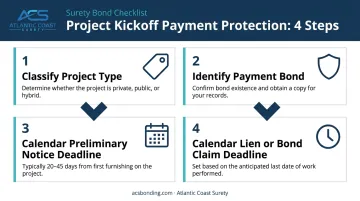
Knowing the rules is only useful if you act on them before work begins. At project kickoff:
- Confirm whether the project is private, public, or hybrid
- Identify whether a payment bond exists and obtain a copy
- Calendar the preliminary notice deadline (often 20–45 days from first furnishing)
- Calendar the lien or bond claim deadline based on anticipated last date of work
Requirements vary by state, project type, and tier status. Consult a construction attorney in the project's state — the specific rules governing your situation are the only ones that matter when a payment dispute lands in court.
Frequently Asked Questions
How do bonds work for contractors?
A surety bond is a three-party agreement where the surety (bonding company) guarantees the obligee (project owner or government agency) that the contractor will fulfill their obligations. Coverage varies by bond type — payment to subcontractors and suppliers, project completion, or regulatory compliance.
Which bonds commonly protect the owner against contractor default and unpaid bills?
Payment bonds protect owners and lower-tier parties from unpaid bills by ensuring subcontractors and suppliers are compensated. Performance bonds protect the owner from contractor default by guaranteeing project completion. Both are typically required together on public projects under the Miller Act.
Can you bond around a lien?
This is called "bonding off" a lien. A property owner or general contractor obtains a lien release bond, which transfers the claim from the property title to the bond. This allows the project or sale to proceed while the claimant still pursues payment through the surety within the applicable deadline.
What are the three C's a surety will consider before bonding a contractor?
Sureties evaluate Character (reputation, integrity, and track record), Capacity (technical ability and experience to complete the work), and Capital (financial strength, assets, working capital, and creditworthiness) before issuing a bond. A weak score in any single area can be enough to deny the bond.
Can a subcontractor file both a lien and a bond claim on the same project?
On private projects where a payment bond is in place, both remedies may be available — though the bond claim process is typically simpler and faster. On public projects, the payment bond claim is the exclusive remedy, since liens cannot be filed against government-owned property.
What happens if you miss the deadline to file a mechanics lien?
Missing the statutory lien deadline in most states results in a permanent loss of lien rights. There are no extensions. Contractors should document their last date of work carefully and file — or consult an attorney — well before the deadline expires.