Most guides stop at "the bond is 10% of your annual duties." That's accurate, but incomplete. Minimums, rounding rules, CBP's discretionary authority, and new importer requirements all shape the final number—and getting it wrong creates real compliance exposure.
This guide covers exactly how CBP and surety companies arrive at a specific bond amount, who can push that number higher, and when you need to reassess yours.
TL;DR
- A continuous customs bond covers all U.S. import entries for a rolling 12-month period, renewing annually until terminated
- Standard formula: 10% of total duties, taxes, and fees paid to CBP in the prior 12 months, with a $50,000 mandatory minimum
- CBP can require a higher bond amount through a sufficiency review if your risk profile warrants greater coverage
- New importers calculate bond amounts using estimated 12-month duty projections, not an automatic $50,000 default
- An undersized bond risks CBP sufficiency notices, cargo holds, or suspension of import privileges
What Is a Continuous Bond?
A continuous bond is a standing financial guarantee executed on CBP Form 301 under 19 CFR 113.62, binding the importer (the principal) and a Treasury-listed surety company to the United States. The bond ensures all duties, taxes, fines, and penalties will be paid and that the importer complies with applicable customs laws and regulations.
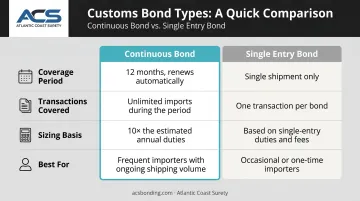
Under CBP Form 301, a continuous bond remains in force for one year from its effective date and continues for each succeeding annual period until formally terminated. Understanding how it differs from a single entry bond clarifies when a continuous bond is the right choice:
| Feature | Continuous Bond | Single Entry Bond |
|---|---|---|
| Coverage period | 12 months, auto-renewing | One specific shipment |
| Transactions covered | All import entries during the term | One transaction only |
| Sizing basis | Annual duty volume | That shipment's duties and value |
| Best for | Frequent importers | Occasional or one-time imports |
Who Typically Holds a Continuous Bond
Under Activity Code 1 (Basic Importation and Entry), the bond applies to:
- Regular importers bringing goods into the U.S. on a recurring basis
- Customs brokers filing entries on behalf of importers
- Businesses with ISF obligations, since 19 CFR 113.62 incorporates Importer Security Filing compliance — carrying $5,000 in liquidated damages per ISF default
The Standard Formula: How CBP Calculates Continuous Bond Amounts
The Core Rule
CBP's official guidance, A Guide for the Public: How CBP Sets Bond Amounts (Publication No. 3569-0224, February 2024), establishes the formula for Activity Code 1 continuous bonds:
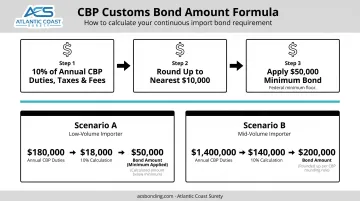
Bond Amount = 10% of total duties, taxes, and fees paid to CBP in the preceding 12 months
Two hard rules apply:
- The result can never be less than $50,000, regardless of how low 10% calculates
- The result is rounded up to the nearest $10,000 increment up to $100,000, and in $100,000 increments above that
What Counts in the Calculation
The formula includes CBP-assessed charges:
- Customs duties
- Merchandise Processing Fees (MPF), governed by 19 CFR 24.23
- Harbor Maintenance Fees (HMF), governed by 19 CFR 24.24
- Other CBP-assessed charges
Broker service fees and freight costs are not CBP-assessed charges and are not part of the formula base.
Illustrative Example
Scenario A — Low-volume importer:
- Annual duties, taxes, and fees paid to CBP: $180,000
- 10% of $180,000 = $18,000
- $18,000 is below the $50,000 minimum
- Required bond amount: $50,000
Scenario B — Mid-volume importer:
- Annual duties, taxes, and fees paid to CBP: $1,400,000
- 10% of $1,400,000 = $140,000
- Rounded up to nearest $100,000 increment above $100,000 = $200,000
- Required bond amount: $200,000
Figures are illustrative only.
Where the Formula Comes From
Understanding who sets these numbers matters when an importer is reviewing their bond requirements. The formula applies to Activity Code 1 importer bonds, and the required amount is determined entirely by CBP:
- CBP's role: CBP's Office of Finance, Revenue Division conducts sufficiency reviews and sets the required bond amount
- The surety's role: Underwrite and issue a bond at or above that amount — the floor is not negotiable
Factors That Push Your Bond Amount Above the Minimum
CBP has discretionary authority to require a bond amount higher than what the standard formula produces. This is called a bond sufficiency determination, and it's more common than many importers expect.
Risk Factors CBP Evaluates
CBP's Insufficient Bond guidance identifies several triggers that can prompt a required increase:
- Outstanding debt or unpaid duties — debit vouchers, unresolved CBP demand letters
- Non-compliance history — prior CBP violations, open enforcement actions, active audits
- Missing or invalid documentation — invalid importer of record number, missing required bond riders, non-deliverable mailing address
- Sudden volume spikes — significant increases in shipment value or frequency that outpace the prior-year calculation
The Antidumping and Countervailing Duty (ADD/CVD) Effect
ADD/CVD orders are where bond amounts jump most sharply. CBP notes that AD/CVD cash deposit rates range from 0% to 3,403.96% — rates that dwarf standard duty percentages.
When an importer sources goods subject to ADD/CVD orders, the effective duty rate on each entry multiplies. Applying the 10% formula to that inflated annual duty burden produces bond requirements well above the $50,000 minimum. Importers of affected goods routinely require bonds of $100,000, $200,000, or more, depending on volume and ADD/CVD rates.
The Tariff Shift Problem
ADD/CVD exposure compounds when broader tariff actions enter the picture. Significant increases tied to Section 301 or Section 232 actions can cause an importer's annual duty liability to jump sharply mid-year — meaning a bond correctly sized in January may be insufficient by July.
When CBP determines an existing bond is insufficient, it issues a formal sufficiency notice requiring the importer to replace or strengthen the bond within a specified timeframe. Entries may be held from immediate release until a compliant bond is in place.
In more serious cases, CBP can void the importer record entirely. Monitoring your bond's adequacy throughout the year — not just at renewal — is essential when tariff conditions are shifting.
How Bond Amounts Are Set for New Importers
The Starting Point
The standard formula depends on 12 months of prior CBP duty payments. A brand-new importer has no such history.
Per CBP's 2024 guidance, no-history importers use estimated duties, taxes, and fees expected to accrue over the next 12-month period, subject to the $50,000 floor. CBP doesn't automatically assign every new importer a $50,000 bond — the floor applies only when projected duties produce a 10% figure below that threshold.
Sizing the Bond Proactively
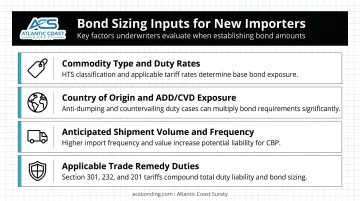
New importers who provide realistic duty projections can size their bond more accurately from day one. The relevant inputs include:
- Commodity type and applicable duty rates
- Country of origin (particularly relevant for ADD/CVD exposure)
- Anticipated shipment volume and frequency
- Whether goods are subject to any Section 301, Section 232, or other trade remedy duties
Starting with an appropriately sized bond—rather than defaulting to the minimum—reduces the risk of receiving a mid-year sufficiency notice from CBP.
When the Formula Takes Over
Once a full year of import activity is on record, the proactive estimate gives way to hard data. At the first annual renewal, CBP applies the standard 10% formula to the actual 12-month duty base. The bond amount is reassessed at that point and adjusted accordingly.
Common Misconceptions About Continuous Bond Amounts
Misconception 1: The $50,000 Minimum Is Sufficient for Most Importers
The $50,000 floor only applies when 10% of your annual duties is less than $50,000—meaning annual CBP charges below $500,000. Importers above that threshold are required to carry more. Carrying an undersized bond isn't just a technicality; it creates direct compliance risk, including cargo holds and entry rejections.
Misconception 2: The Bond Amount and the Bond Cost Are the Same Thing
These are two separate figures:
- Bond amount: The maximum liability covered — the number CBP requires, such as $50,000 or $200,000
- Bond premium: The annual fee paid to the surety company for issuing the bond, calculated as a percentage of the bond amount
CBP's own guidance notes the premium is typically a small percentage of the bond amount, scaling upward as the bond amount increases. The premium is not the coverage amount.
Misconception 3: The Bond Auto-Adjusts When Your Import Volume Changes
Per CBP Form 301, a continuous bond remains in force for each succeeding annual period until terminated. It renews at the amount on file—not at a recalculated amount based on current trade volume. The importer bears responsibility for monitoring adequacy and initiating changes. That makes knowing when to reassess just as important as setting the right amount initially.
When to Trigger a Bond Review
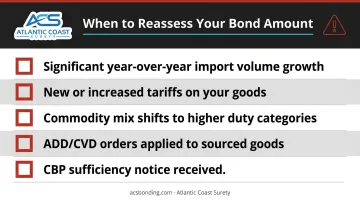
Don't wait for CBP to send a notice. Reassess your bond amount when:
- Annual import volume grows significantly year over year
- You begin importing goods subject to new or increased tariffs
- Your commodity mix shifts to categories with higher duty rates
- ADD/CVD orders are applied to goods you source
- Any CBP sufficiency notice is received
Atlantic Coast Surety works with insurance agents and brokers to evaluate whether an importer's current bond amount fits their trade profile. With access to A-rated, T-listed carriers across standard and specialty markets, the team can support both initial placement and adjustments as import activity changes.
Frequently Asked Questions
What does a continuous bond mean?
A continuous bond is an annually renewing financial guarantee to CBP, executed under 19 CFR 113.62, that covers all import entries made by the importer during the bond period. It ensures duties, taxes, and fees will be paid and that the importer complies with applicable customs law.
How do you calculate a continuous bond amount?
Take 10% of total duties, taxes, and fees paid to CBP in the prior 12 months, round up to the nearest $10,000 increment, and apply a $50,000 minimum floor. For new importers, use estimated 12-month duty projections instead of historical data.
What is the difference between a single entry bond and a continuous bond?
A single entry bond covers one specific shipment and is sized to that transaction's duties and value. A continuous bond covers all import entries across a full 12-month period under a single pre-approved amount that renews annually.
How much does a continuous bond cost?
The annual cost is a premium paid to the surety company, calculated as a percentage of the bond amount. The actual rate depends on the importer's credit profile and the total bond amount required. Contact a surety specialist for a specific quote.
What happens if my continuous bond amount is insufficient?
CBP can issue a sufficiency notice requiring the importer to increase the bond amount within a specified period. Until a compliant bond is in place, CBP may preclude cargo from immediate release. In unresolved cases, CBP can void the importer record.
How often should I review my continuous bond amount?
Review at each annual renewal. Outside of that, trigger a review if import volume grows significantly, new tariffs apply to your goods, your commodity categories shift, or you receive any communication from CBP's Revenue Division about bond sufficiency.