This guide covers all of it: what a continuous bond is, who needs one, the step-by-step application process, how amounts are determined, and what to expect once your bond is filed.
Key Takeaways
- A continuous US customs bond (CBP Activity Code 1) covers all US ports of entry under one bond number and stays active until formally terminated.
- The minimum bond amount is $50,000; above $500,000 in annual duties, the amount scales to 10% of prior-year duties, taxes, and fees.
- You'll need basic business information and an EIN or CBP importer number to apply through a Treasury-authorized surety agent.
- Standard $50,000 bonds can be approved same-day; CBP typically takes 1–2 weeks to process and activate a bond.
- Plan ahead — don't wait until your first shipment is on the water.
What Is a Continuous US Customs Bond and Who Needs One?
A continuous customs bond — formally CBP Activity Code 1 — is a financial guarantee that binds three parties: the importer (principal), the issuing insurance company (surety), and US Customs and Border Protection (CBP) as the beneficiary.
As defined in CBP Form 301, the principal and surety bind themselves to the United States for the bond amount, covering obligations like paying duties, producing documents, and redelivering merchandise when required.
One bond number covers every US port of entry. Per CBP Directive 3510-004, a continuous bond approved in one district is honored by all districts under normal circumstances — so you're not managing separate bonds for New York, Los Angeles, and Chicago.
Continuous Bond vs. Single-Entry Bond
| Feature | Continuous Bond | Single-Entry Bond |
|---|---|---|
| Coverage | All entries, all ports | One transaction only |
| Best for | Repeat commercial importers | Occasional or one-time imports |
| Cost efficiency | Higher upfront, lower per-entry | Low upfront, costly at volume |
| Duration | Until formally terminated | Expires after one entry |
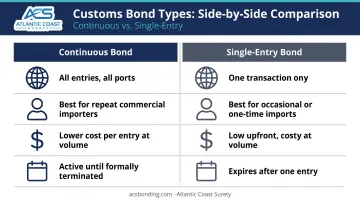
That cost difference matters in practice. CBP requires a bond when commercially valued goods worth $2,500 or more are imported through a formal entry, and for any business importing regularly, a single-entry bond quickly becomes impractical.
Who Is Responsible for Obtaining the Bond?
The US importer of record is responsible for securing the bond. That includes:
- A domestic business with a US Employer Identification Number (EIN)
- A foreign company importing without a US entity — these importers can obtain a CBP-assigned importer number via CBP Form 5106
- Any party taking legal responsibility for the shipment at the US border
A licensed customs broker can confirm your importer of record status before you apply.
How to Apply for a Continuous US Customs Bond: Step by Step
The application doesn't go directly to CBP. It runs through a Treasury-authorized surety agent, who handles underwriting and electronic filing on your behalf. For standard $50,000 bonds, the surety-side approval is often same-day. CBP's processing, however, typically takes 1–2 weeks for new bonds.
Step 1: Gather Your Required Information
Have the following ready before you contact a surety agent:
- Legal company name and business type (corporation, LLC, partnership, sole proprietor)
- Business address
- Employer Identification Number (EIN) or Social Security Number
- CBP importer number (or note that a customs broker can help obtain a CBP-assigned number for foreign importers)
- Description of goods being imported
- Estimated annual import value
- Years in business
Step 2: Select a Treasury-Authorized Surety Agent
The surety agent issues the bond and files it with CBP. Under 19 CFR Part 113 Subpart D, CBP only accepts bonds from corporate sureties listed in Treasury Department Circular 570.
When evaluating agents, look for:
- Dedicated bond-only focus (not a freight forwarder offering bonds as a side service)
- Access to A-rated, Treasury-listed carriers
- In-house underwriting authority for faster approvals
- Demonstrated experience with customs bond submissions
Atlantic Coast Surety, for example, is a bond-only agency with 20+ years of experience and direct access to A-rated, Treasury-listed providers — the standard CBP requires for bond acceptance.
Step 3: Complete and Sign the Application
The application collects the information from Step 1, plus a Power of Attorney (POA) granting the surety agent authority to file the bond with CBP on your behalf. Both documents must be signed by an authorized officer of your company. Per CBP's continuous bond guidelines, CBP requires a separate POA for each distinct legal entity.
Step 4: Underwriting and Approval
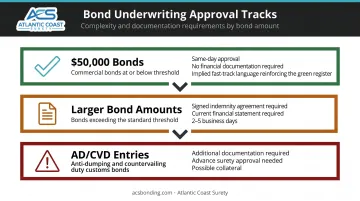
- $50,000 bonds are typically approved same-day with no financial documentation required.
- Larger bond amounts require a signed indemnity agreement and a current financial statement (audited, reviewed, or compiled); expect 2–5 business days.
- AD/CVD entries require additional documentation and advance surety approval before any such entries are made. CBP classifies anti-dumping and countervailing duties as a Priority Trade Issue and may require security beyond the continuous bond amount.
Step 5: Electronic Filing with CBP
Once approved, the surety agent files the bond electronically with the CBP Revenue Division in Indianapolis. CBP assigns a unique bond number tied to your CBP importer number. From that point forward, any licensed customs broker or freight forwarder filing entries on your behalf at any US port can reference that bond number.
How Bond Amounts Are Determined
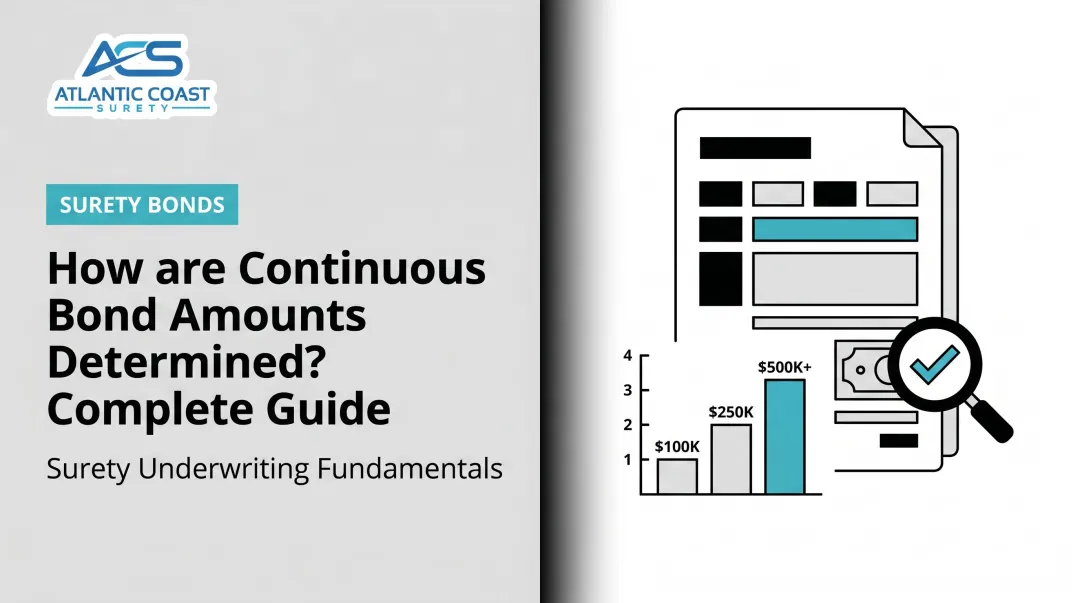
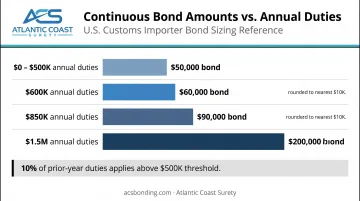
The minimum continuous bond amount is $50,000, as set by CBP Directive 3510-004. For importers whose annual duties, taxes, and fees exceed $500,000, the bond amount must equal at least 10% of prior-year totals.
Rounding Rules
- Up to $1,000,000 in annual duties: Bond amount rounds to the nearest $10,000 increment
- Over $1,000,000 in annual duties: Bond amount rounds to the nearest $100,000 increment
Practical Examples
| Annual Duties, Taxes & Fees | Minimum Bond Amount |
|---|---|
| $0 – $500,000 | $50,000 |
| $600,000 | $60,000 |
| $850,000 | $90,000 |
| $1,500,000 | $200,000 |
AD/CVD Bonds: A Different Calculation
Importers with anti-dumping or countervailing duty entries face higher bond requirements and significantly more scrutiny from sureties. The long-tailed risk of AD/CVD liability — where duty assessments can arrive years after entry — makes these bonds more complex to underwrite. Collateral may be required depending on the surety's assessment of the risk.
Sizing Your Bond for Future Import Volume
When setting your bond amount, project your next 12 months of import activity. If your import volume is growing, set a higher bond upfront. Responding to a CBP letter of insufficiency later is more disruptive than sizing the bond correctly from the start.
What Happens After Your Bond Is Filed
Activation Timeline
CBP processes bonds electronically via ACE eBond. According to CBP's ACE eBond page, sureties reported bonds fully processed in as little as 30 seconds once submitted electronically. However, CBP's own help documentation notes that the full review and approval process typically takes 1 to 2 weeks for new continuous bonds. Apply well before your first planned shipment.
Ongoing Bond Status
A continuous bond has no expiration date. Under CBP Form 301, it remains in force for one year from the effective date and renews automatically each year until terminated. What does repeat annually is the premium payment to the surety — if it goes unpaid, the surety will initiate formal termination. To confirm a bond is still active, run a query with CBP directly; no new bond document is issued each year.
Termination Rules
Under 19 CFR 113.27:
- Principal termination: Written request to the Revenue Division; takes effect on the requested date if at least 10 business days after CBP receives it.
- Surety termination: Requires reasonable notice (30 days counts as reasonable notice unless CBP accepts a shorter period).
Importer Obligations After Activation
Once your bond is active, you're responsible for:
- Paying all applicable duties and fees on time
- Maintaining accurate CBP records for 5 years from date of entry (per 19 CFR Part 163)
- Updating name or address changes with CBP via Form 5106 (filed through a customs broker)
- Monitoring bond sufficiency as import volumes grow
If CBP issues a letter of insufficiency, you have 15 days to increase the bond limit or arrange a replacement. If no action is taken, CBP will place the bond in insufficient status, blocking new entries until resolved.
Common Misconceptions About Continuous Customs Bonds
"The bond renews every year."
It doesn't. The bond itself is continuous — only the annual premium payment cycle repeats. If you receive annual billing notices from a freight forwarder or broker, those may reflect service fees or markup, not an actual renewal of the legal instrument. Missing the premium payment triggers formal termination by the surety, which is a different process entirely.
"The bond limit is a spending cap."
The bond amount is a limit of liability — the maximum the surety is on the hook for per bond year. It doesn't limit how many entries you can file or the total value of goods you can import. An importer with a $50,000 bond can make unlimited entries, provided CBP determines the bond remains sufficient relative to duties owed. As the NCBFAA noted in 2025, importers should actively monitor bond sufficiency — especially during periods of tariff changes — rather than treating the bond amount as fixed.
"All customs bonds are the same."
CBP Form 301 is standardized, but the surety behind the bond is not interchangeable. Under 19 CFR Part 113 Subpart D, CBP only accepts bonds from corporate sureties listed in Treasury Department Circular 570. A bond from a financially weak or non-Treasury-listed carrier can be rejected at port. Confirm your bond comes from an A-rated, Treasury-listed surety before assuming it will be accepted.
With these misconceptions cleared up, you're in a better position to apply for — and maintain — a bond that actually holds up under CBP scrutiny.
Frequently Asked Questions
What is a continuous bond application?
It's the paperwork submitted to a Treasury-authorized surety agent to obtain a CBP Activity Code 1 continuous import bond. It typically includes a short application form and a Power of Attorney, and it initiates the underwriting and electronic filing process with CBP.
How long does it take to get a continuous bond?
Surety-side approval for a standard $50,000 bond is often same-day. CBP's review and full activation of a new continuous bond typically takes 1–2 weeks, so apply well before your first planned shipment.
What is the minimum amount for a continuous customs bond?
The minimum is $50,000, which covers importers paying up to $500,000 in annual duties, taxes, and fees. Above that threshold, the bond amount must equal at least 10% of prior-year duties, rounded per CBP's rounding guidelines.
Can I use my continuous bond at multiple ports of entry?
Yes. A continuous bond covers all US ports of entry under a single bond number. Any licensed customs broker or freight forwarder acting on your behalf can reference that bond number when filing entries at any port nationwide.
What happens if my bond becomes insufficient?
CBP will issue a letter of insufficiency giving you 15 days to increase the bond limit or obtain a replacement bond. If unresolved, CBP places the bond in insufficient status, which blocks new entries until the issue is corrected.
Do I need a customs broker to apply for a continuous bond?
A customs broker isn't required to obtain the bond itself (that's handled through a surety agent). However, a licensed broker is essential for filing import entries and can assist with the Power of Attorney and CBP importer number.