
Most notary commissions run for four years, and the surety bond tied to your commission expires with it. That means every term requires a new bond before you can legally continue your work. The renewal process involves distinct steps, state-specific requirements, and timing windows that vary considerably across the country.
This guide covers what a notary bond actually is, how bond renewal differs from commission renewal, a step-by-step walkthrough of the process, what affects cost and timing, and the most common mistakes notaries make.
Key Takeaways
- A notary bond protects the public — not you personally — against harm caused by your errors or misconduct, and it must be renewed each commission term.
- Buying a new bond alone does not renew your commission; it is one required document within the full state application.
- Most states open the renewal window 90 to 180 days before expiration — start early to avoid gaps.
- Standalone 4-year bond premiums typically range from $25 to $50, varying by state.
- A surety provider using A-rated, state-authorized carriers reduces the risk of your bond being rejected.
What Is a Notary Bond and Why Does It Need Renewal?
As defined by the Surety & Fidelity Association of America, a surety bond is a written agreement guaranteeing compliance with a law or regulation. For notaries, this takes the form of a three-party agreement among the notary (the principal), the state or public (the obligee), and the surety company.
The key distinction: the bond protects the public from financial harm if you make a negligent mistake or commit misconduct — not you. If a claim is paid out, the surety can seek repayment from you personally.
Renewal is required because notary bonds are issued to align with the commission term, typically four years. When your commission expires, so does the bond attached to it. A new bond must be obtained for each new term before you can resume notarizing.
Bond vs. E&O Insurance
These two products are frequently confused, but they serve different purposes:
- Notary bond — protects the public; required by most states
- E&O insurance — protects you from covered unintentional mistakes or false claims; generally optional
Neither substitutes for the other. The bond is the legal requirement; E&O coverage protects your own finances when claims arise — which is why many notaries carry both.
Notary Bond Renewal vs. Notary Commission Renewal: Key Differences
Bond renewal and commission renewal are often confused — but confusing them can leave you legally unable to notarize.
Commission renewal is the broader process managed by your state's commissioning authority — usually the Secretary of State. It typically involves:
- Submitting a renewal application
- Paying a state filing fee
- Providing proof of your new bond
- In some states, filing an oath of office or passing an exam
Bond renewal is one required component within that larger process. You purchase a new bond from a surety provider, then submit the bond form as part of your commission renewal application.
Wisconsin's Department of Financial Institutions makes this distinction explicit: buying a bond alone does not qualify you to perform notarizations, and insurance companies are not authorized to issue commissions or commission expiration dates.
Skipping either step creates legal exposure. Two failure patterns come up repeatedly:
- A notary purchases a renewal bond but never completes the state commission application — and is not legally authorized to notarize until that application is approved.
- A notary submits the commission application without a valid bond — the application is rejected in states where a bond is mandatory. In California, the commission is voided entirely if the bond isn't filed within 30 calendar days of commission commencement.
How to Renew Your Notary Bond: Step-by-Step
The process follows a predictable sequence, but forms, fees, and timelines vary by state. Always check your state commissioning authority's website before starting.
Step 1: Confirm Your Renewal Window
Most states allow renewal submissions well before expiration. Know your window:
| State | Renewal Window |
|---|---|
| Wisconsin | Up to 6 months before expiration |
| Washington | Up to 120 days before expiration |
| New York | 90 days before expiration |
| Texas | No earlier than 90 days before expiration |
| Pennsylvania | 2 to 3 months before expiration |
| Arizona | Up to 2 months before expiration |
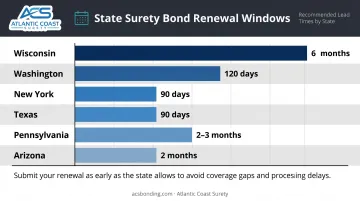
Submit as early as your state allows. State processing times vary, and waiting until the deadline risks a gap in your commission authority.
Step 2: Verify Your State's Current Bond Amount
Required bond amounts differ considerably by state — and they can change between commission terms. Verify the current amount with your state authority before purchasing.
Current examples from official sources:
- California — $15,000
- Pennsylvania — $25,000 for notaries newly appointed or reappointed on or after March 28, 2026 (up from $10,000)
- Texas — $10,000
- Florida — $7,500
- Illinois — $5,000 (standard); $30,000 for remote notarization
- Wisconsin — $500
Step 3: Purchase a New Bond from a Licensed Surety Provider
Contact a surety bond provider, provide your name, state, and commission term information, and receive your bond form. Most standard notary bonds are issued same day or next business day.
When selecting a provider, confirm the carrier is licensed to write surety bonds in your state. Each state has specific requirements:
- Texas — bond must come from a Texas-licensed bonding company
- Washington — company must be licensed to do surety in Washington
- Florida — surety must be approved and filed with the Department of State
Atlantic Coast Surety sources bonds through A-rated and T-listed carriers, helping ensure the bond meets state acceptance standards before submission.
Step 4: Complete Your State's Commission Renewal Application
Once you have your signed bond form, complete the commission renewal application — often available online through the Secretary of State's portal. Depending on your state, you may also need to attach:
- A signed oath of office
- A course completion certificate (Wisconsin, Illinois)
- A state filing fee payment
Step 5: Submit and Wait for Your New Commission Certificate
Submission methods vary:
- Online: Washington, Illinois, Texas (SOS Notary Portal)
- Mail or in person: Arizona (Phoenix or Tucson offices), Wisconsin
Do not represent yourself as commissioned under the new term until the state issues your new commission certificate. Your previous commission governs until then.
Step 6: Update Your Notary Seal If Needed
Most state seals must include the commission expiration date. When your term changes, a new seal is typically required.
State-specific guidance:
- Florida — use your current seal until expiration; do not use the new seal until the first day of your new commission
- Texas — seal must include your name and the commission expiration date
- California — seal must include commission expiration date, county, sequential ID, and manufacturer ID
Check your state rules before ordering a new seal — if your current seal doesn't display an expiration date, it may not require replacement.
Key Factors That Affect Your Notary Bond Renewal
Three variables most commonly affect how your renewal unfolds: timing, cost, and any changes to your personal information. Here's what to know about each.
Timing and Lapsed Commissions
Missing your renewal window has real consequences:
- Arizona — if the commission expires before the new certificate is received, you must stop all notarial acts; no grace period
- Illinois — no grace period; wait for a new commission and seal before resuming services
- Washington — if the license expires, it cannot be renewed; you must apply as a new applicant
- New York — renewal allowed up to 6 months after expiration, according to Washington County, NY government records; after that window closes, a new application is required
Bond Cost
Standalone 4-year notary bond premiums are generally affordable. Representative benchmarks from licensed providers:
- Arizona ($5,000 bond) — approximately $25
- Pennsylvania ($25,000 bond) — approximately $30
- Florida ($7,500 bond) — approximately $35
- Texas ($10,000 bond) — approximately $50

Note: These figures reflect premium costs only — state filing fees are billed separately.
Name or Address Changes
If your legal name or county of principal place of business has changed between terms, additional documentation is typically required:
- Texas — name change requires a rider or endorsement from the surety plus a filing fee, submitted through the SOS Notary Portal
- Pennsylvania — requires official evidence (marriage certificate, court order) and a new rubber stamp seal before using the updated name
- California — address changes must be reported within 30 days; moving to a new county and filing a new oath and bond there requires an updated stamp reflecting the new county
Common Mistakes to Avoid When Renewing Your Notary Bond
1. Assuming the Bond Purchase Completes the Renewal
Buying a new bond is one step, not the finish line. The bond form must be submitted as part of a complete commission renewal application to the state. Notarizing before your new commission is issued is unauthorized practice.
2. Confusing the Bond with E&O Insurance
These are distinct products. E&O covers you personally for unintentional mistakes; the bond protects the public. States require the bond — E&O is typically optional. Purchasing one does not satisfy the requirement for the other.
3. Waiting Too Long to Start
Starting renewal the week before expiration is a common mistake. State processing takes time, and even small delays can leave you unable to legally notarize. Build in at least 90 days — earlier if your state opens the renewal window sooner.
4. Overpaying for Bundled Packages
Some providers bundle bonds with stamps, association memberships, or supply kits and price the package significantly higher than the bond alone. You are only legally required to purchase the bond. If your existing seal is still valid, don't pay for a new one as part of a package deal.
Frequently Asked Questions
How do I renew my notary bond?
Contact a licensed surety bond provider, purchase a new bond for your upcoming commission term, and submit the signed bond form with your state's commission renewal application. The exact forms and filing method depend on your state; check your Secretary of State's website for current requirements.
What should I do if my notary stamp expires?
Notary stamps don't expire independently; they reflect your commission expiration date. A new commission generally requires a new stamp showing the updated date, though some states allow the existing seal if it displays no expiration. Confirm your state's rules before ordering.
Is notary bond renewal the same as notary commission renewal?
No. Bond renewal means purchasing a new surety bond from a provider. Commission renewal is the full state process: application, fee, oath, and bond submission. The bond is one required component of commission renewal, not a substitute for it.
How much does it cost to renew a notary bond?
Standalone 4-year bond premiums typically range from $25 to $50, depending on the state and required bond amount. State filing fees are charged separately, so compare providers and purchase only what you need.
How far in advance should I renew my notary bond?
Most states allow renewal applications 90 to 180 days before expiration. Starting at least 90 days early is advisable in all states, given variable processing times. Wisconsin allows up to six months, which gives notaries particularly generous lead time.
What happens if my notary bond expires before I renew?
Notarizing with an expired bond or commission is unauthorized and can result in invalid notarizations and personal liability. Grace periods vary: New York allows renewal up to six months after expiration, while Arizona and Illinois offer none. Once any grace period closes, you may need to apply as a new notary entirely.