Introduction
Many West Virginia contractors submit their licensing applications only to hit a wall: the wrong bond, a missing bond, or no bond at all. Whether you're a general contractor, specialty trade contractor, or residential builder, the bonding requirement is non-negotiable — and knowing which bond applies to your specific work type is what separates a smooth approval from weeks of back-and-forth with the licensing board.
West Virginia doesn't have a single universal "contractor license bond" that applies to everyone. Instead, different bond requirements apply depending on your work type, whether you have employees, and whether you're bidding public or private projects. Most contractors discover this only after their application stalls.
This guide walks through what contractor bonds are, the specific types required under WV law, how the bonding process works, what it costs, and the common misconceptions that catch even experienced contractors off guard.
TL;DR
- A West Virginia contractor bond is a three-party surety instrument that protects clients, workers, and project owners — not the contractor.
- WV requires a wage bond for contractors with employees in commercial construction and a performance/payment bond for public works projects (WV Code §38-2-39).
- Bond premiums typically run 0.5%–3% of the required bond amount; poor credit history results in higher rates.
- Standard bonds can often be issued within 24–48 hours through a licensed surety provider.
- A surety bond and general liability insurance serve different purposes; contractors typically need both.
What Is a West Virginia Contractor License Bond?
A contractor license bond is a three-party written agreement — between the contractor (the principal), the entity requiring the bond (the obligee, such as the state or a project owner), and the surety company that underwrites the bond.
The bond does not protect the contractor. It provides financial recourse to injured parties — clients, workers, subcontractors, and material suppliers — if the contractor fails to meet contractual, legal, or wage obligations.
How a Surety Bond Differs From Insurance
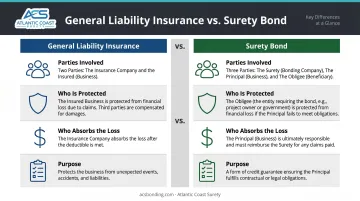
Many contractors assume their general liability policy covers bond requirements. It doesn't. As NASBP explains, traditional insurance is a two-party agreement that compensates the insured against unforeseen losses. A surety bond is a three-party performance guarantee — the surety pays a valid claim but then seeks full reimbursement from the contractor.
| General Liability Insurance | Surety Bond | |
|---|---|---|
| Parties involved | 2 (insurer + insured) | 3 (surety + principal + obligee) |
| Who is protected | The contractor | Third parties (clients, workers) |
| Who absorbs the loss | The insurer | The contractor (via reimbursement) |
| Purpose | Cover unforeseen losses | Guarantee performance or payment |
How a Bond Pays Out
When a valid claim is filed, the surety investigates and, if justified, pays the claimant up to the bond's penal sum. The contractor is then legally obligated to repay the surety in full. There is no shared loss — the full financial consequence falls on the contractor.
Types of Bonds Required for West Virginia Contractors
West Virginia does not impose a single statewide contractor license bond on every licensee. Instead, several distinct bond types apply depending on your work type, whether you have employees, and whether projects are public or private.
Wage Bond
WV Code §21-5-14 requires contractors engaged in commercial construction, mining, or mineral transportation with employees to post a wage bond with the WV Division of Labor. The bond secures employee wages and fringe benefits.
Bond amount: Gross payroll for four weeks at full capacity, plus 15% for benefits.
Companies with at least $100,000 in available assets may qualify for an exemption. However, they must still file a completed Wage Bond Status Affidavit with the WV Division of Labor — signed, notarized, and accurate.
Claiming the exemption does not eliminate the filing requirement.
For wage bond guidance, contact the WV Division of Labor – Wage & Hour Section at WageandHour@wv.gov or 304.558.7890.
Public Works Performance and Payment Bond
WV Code §38-2-39 requires public agencies contracting for construction, improvement, or repair of public buildings or structures to mandate a performance and payment bond from the contractor.
Key requirements under this statute:
- Bond amount: At least equal to the reasonable cost of materials, machinery, equipment, and labor required to complete the contract
- Protected parties: Material suppliers, equipment and machinery furnishers, labor performers, and their assigns
- Recording requirement: The bond must be executed, delivered, and recorded with the county clerk where the work will be done before the contract becomes binding and effective
This means no public works contract is legally enforceable until the bond is on file with the county clerk.
Local and Municipal License Bonds
Beyond state statute, some WV cities and counties impose their own bonding requirements as a condition of pulling permits or operating locally. These vary by jurisdiction:
- Charleston may require nonresident contractors to post a corporate surety bond equal to 6% of the contract amount to secure business and occupation tax obligations
- Huntington requires a bond before issuing a street excavation or opening permit — $1,000 for a single opening or $5,000 for unlimited openings over 12 months
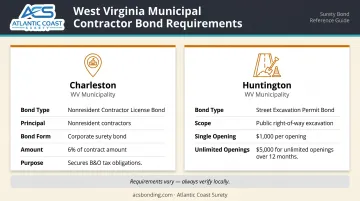
Always verify local requirements with the specific municipality before starting work. Requirements differ city to city and are not captured in state statute.
Contract Bonds for Private Projects
Private project owners and general contractors may require subcontractors to carry performance or payment bonds as a contractual condition. No statewide mandate applies to private-sector work, but project owners and general contractors commonly write bonding requirements into contracts — particularly on larger commercial jobs.
Common bond types required on private projects include:
- Performance bonds guaranteeing project completion per contract terms
- Payment bonds protecting subcontractors and suppliers from non-payment
- Bid bonds confirming a contractor's commitment before award
Why West Virginia Contractors Need a Bond
West Virginia law ties real legal exposure to unlicensed contracting. Operating without the required bond isn't a paperwork oversight — it's a statutory violation with financial and criminal consequences.
Compliance Consequences under WV Code §30-42-14 for operating without proper licensing include:
- First offense: $200 to $1,000 fine
- Second offense: $500 to $5,000 fine or jail time
- Repeat offenses: Increased jail exposure
For public works projects, the contract itself is not legally binding or effective until the bond is recorded with the county clerk per WV Code §38-2-39.
Commercial Consequences
The stakes extend beyond fines. A bond signals financial credibility to municipalities, project owners, and general contractors. Many public agencies and commercial clients won't award contracts to unbonded contractors — even when state law doesn't technically require it for that project type.
Unbonded contractors also face greater difficulty enforcing mechanics liens, which limits their ability to recover unpaid amounts when payment disputes arise.
How to Get a Contractor License Bond in West Virginia
Getting bonded follows a predictable path once you know the steps. Here's how it works:
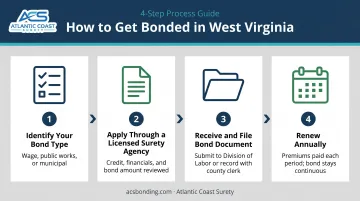
Step 1: Identify which bond you need
- Hiring employees for commercial construction? → Wage bond (WV Division of Labor)
- Bidding a public works project? → Performance/payment bond (recorded with county clerk)
- Working in a specific municipality? → Verify local permit or license bond requirements
If you're unsure which bond applies to your situation, contact the WV Contractor Licensing Board at CLBoard@wv.gov or 304.356.3928 before moving to the next step.
Step 2: Apply through a licensed surety agency
You'll submit a bond application through a surety provider. The underwriter evaluates your credit profile, years in business, financial statements, and the bond amount required.
Atlantic Coast Surety is a bond-only wholesale agency with 20+ years of experience placing contractor bonds — including wage bonds, performance bonds, and payment bonds — through A-rated and T-listed surety carriers. They work through insurance agents and brokers, so ask your agent about accessing their markets for WV contractor bonds.
Step 3: Receive and file your bond document
Once approved, the surety issues a bond document specifying the bond amount, effective date, and obligee. Submit wage bonds to the WV Division of Labor. For public works bonds, record the document with the county clerk before the contract becomes effective.
Step 4: Renew annually
Most contractor bonds require annual renewal. Premiums are paid each renewal period, and the bond remains continuous as long as premiums are current and no unresolved claims exist.
What Affects the Cost of a West Virginia Contractor Bond
Bond cost is not a flat fee. It's calculated as a percentage of the required bond amount, with the exact rate determined through underwriting.
Premium Ranges
| Applicant Profile | Typical Premium Range |
|---|---|
| Strong credit, established business | 0.5% – 3% of bond amount |
| Challenged credit or newer business | 5% – 10% or higher |
Per NASBP, contract surety bond premiums generally average around 1% for well-qualified applicants. Challenged-credit ranges reflect commercial benchmark data and will vary by bond type and applicant profile.
Key Underwriting Factors
Sureties evaluate applicants based on several criteria:
- Personal credit score — the primary driver for standard bonds
- Years in business
- Business and personal financial statements
- Claims or default history
- Bond amount required by the obligee
Standard wage bonds often require minimal documentation and can move quickly. Larger public works performance and payment bonds typically require more extensive underwriting, including:
- Three years of CPA-prepared financial statements
- Bank letters showing active credit lines
- Work-in-progress schedules
- Subcontractor references
Atlantic Coast Surety works across standard and specialty surety markets to match contractors with the right bond at competitive rates. Contact the team directly for a quote specific to your bond type and applicant profile.
Common Misconceptions About Contractor Bonds in West Virginia
"My general liability policy covers the bond requirement."
It does not. Insurance and surety bonds are legally distinct products. Insurance is a two-party policy protecting the contractor against covered losses. A bond is a three-party guarantee of performance owed to a third party. WV statutes require bonds specifically — liability policies do not satisfy those requirements.
"Once I'm licensed and bonded, all my bond obligations are met."
Not automatically. WV contractors may need a wage bond with the Division of Labor, a public works bond recorded with a county clerk, and a separate local license bond in certain municipalities — each is a distinct requirement with its own obligee (the party the bond protects) and filing process.
"If a claim is filed, the surety covers it and I'm off the hook."
The surety pays the claimant first — then recovers the full amount from the contractor. There is no shared loss. A paid claim is a debt the contractor owes — which is why resolving disputes before a claim reaches the surety is almost always the better financial outcome.
Frequently Asked Questions
How much does a West Virginia contractor license bond cost?
Cost varies by bond type, required bond amount, and your credit profile. Premium is calculated as a percentage of the bond amount — typically 0.5% to 3% for applicants with strong credit, and higher for those with credit challenges. Contact a licensed surety provider for a quote specific to your bond type and financial profile.
How does a West Virginia contractor license bond work?
A bond is a three-party agreement between you (the principal), the entity requiring the bond (the obligee), and the surety company. If you fail to meet your contractual or wage obligations and a valid claim is filed, the surety pays the claimant and then seeks full reimbursement from you.
How long does it take to get a West Virginia contractor license bond?
Standard bonds like wage bonds can often be issued within 24–48 hours of a completed application. Larger public works performance and payment bonds require detailed financial underwriting — such as CPA statements and work-in-progress schedules — and may take longer depending on how quickly documentation is submitted.
What types of bonds can be required from a contractor in West Virginia?
Three main categories apply:
- Wage bonds — required for commercial construction employers with employees under WV Code §21-5-14
- Public works performance and payment bonds — required for public building projects under WV Code §38-2-39
- Local/municipal license bonds — vary by city or county permit requirements
Is a contractor license bond the same as insurance in West Virginia?
No. Insurance protects the contractor from covered losses and is a two-party agreement. A surety bond guarantees your obligations to a third party — clients, workers, or the government. They serve different purposes and cannot substitute for one another in licensing or contract requirements.
What happens if a claim is made against my West Virginia contractor bond?
The surety investigates the claim and, if valid, pays the claimant up to the bond's penal sum. You are then required to repay the surety the full amount paid. Resolving disputes before a formal claim is filed is almost always less costly than letting one proceed.