

This guide covers exactly what a plumbing contractor license bond is, why it's required, how licensing tiers work across states, what bond amounts look like by jurisdiction, and how to get bonded efficiently.
TLDR:
- A plumbing contractor license bond protects consumers and regulators — not the contractor
- Bond amounts are jurisdiction-specific; verified examples range from $5,000 (Oklahoma, Iowa) to $25,000 (Minnesota)
- The premium you pay is a percentage of the bond amount, influenced primarily by your credit score
- Bonding requirements apply at the contractor license level — journeymen and apprentices generally don't need their own bond
- Always verify requirements with your specific licensing authority; state, county, and city rules can all apply simultaneously
What Is a Plumbing Contractor License Bond?
A plumbing contractor license bond is a type of surety bond — a financial guarantee that a licensed plumbing contractor will comply with applicable state laws, local codes, and licensing obligations. It is not insurance for the contractor. It exists to protect consumers and the regulatory body requiring it.
As defined by the Surety & Fidelity Association of America (SFAA), a surety bond is a three-party written agreement involving:
- The obligee — the state agency or local licensing authority requiring the bond
- The principal — the plumbing contractor purchasing the bond
- The surety — the bonding company that issues the bond and backs valid claims
How a Plumbing Contractor Bond Works
If a plumbing contractor performs substandard or fraudulent work that violates their licensing agreement, an affected party — say, a homeowner or government agency — can file a claim against the bond. The surety investigates and may pay damages up to the bond amount.
One point contractors often overlook: if the surety pays a claim, the contractor is legally obligated to reimburse that amount. The bond functions more like a guaranteed line of credit for claimants — not a free safety net for the contractor.
This distinction also explains why bonds and liability insurance are separate requirements. Washington State, for example, requires both a $6,000 plumbing contractor bond and separate liability insurance — because each covers different risks:
- License bond — addresses contractor misconduct or non-compliance with licensing obligations
- Liability insurance — covers the contractor's business against accidents, property damage, or on-site injuries
Plumbing Contractor Bonds vs. Other Bond Types
NASBP classifies license and permit bonds as commercial surety bonds — distinct from contract surety bonds like bid bonds, performance bonds, and payment bonds.
The key practical difference:
- License bonds — ongoing requirements tied to maintaining active licensure
- Contract bonds — project-specific, required for individual construction contracts
Most plumbing contractors carry a license bond continuously and obtain contract bonds on a project-by-project basis as needed.
Why Plumbing Contractors Need to Be Licensed and Bonded
Most states require plumbing contractors — those operating their own plumbing businesses — to hold a contractor-level license backed by a surety bond before they can legally bid, perform, or supervise plumbing work independently.
The penalties for ignoring this are not trivial. Under Washington RCW 18.106.270, contractors face a $500 minimum penalty for a first infraction and up to $5,000 for subsequent violations. Three infractions within 36 months can trigger license suspension for up to two years. Washington's Labor & Industries department conducts active enforcement — a two-day 2025 operation caught 41 individuals for unlicensed plumbing or electrical work and unregistered contracting.
How Licensing Protects Clients and Contractors
Licensing and bonding requirements exist for two reasons:
- Minimum competency standards: Licensing exams and experience requirements verify that contractors actually know their trade
- Financial recourse: If something goes wrong, clients and regulators have a mechanism to recover damages
Operating without proper licensing can also eliminate your ability to get paid. New York case law has established that unlicensed contractors may be barred from filing a mechanics lien to recover unpaid work, leaving wages with no legal path to collect.
One important clarification: bonding requirements apply at the contractor license level. Journeyman and apprentice plumbers working under a licensed contractor generally do not need their own surety bond.
Plumbing Contractor License Requirements: What to Expect
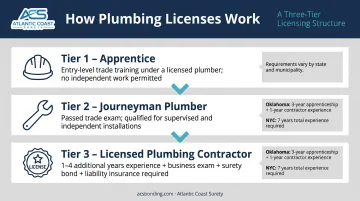
Most states use a tiered licensing structure for plumbers:
Apprentice → Journeyman Plumber → Licensed Plumbing Contractor
The contractor level is the top tier. It's required to independently operate a plumbing business, pull permits, and take on jobs without supervision by another licensed contractor.
Common Requirements Across States
While specifics vary, most contractor license applications include:
- Minimum age of 18
- Verified journeyman-level experience (typically 1–4 additional years beyond journeyman)
- Passing scores on a trade exam and business/law exam
- Payment of a licensing fee
- Proof of a surety bond
- Proof of general liability insurance
Oklahoma's path requires an apprentice-to-journeyman progression including 3 years of trade experience, followed by 1 additional year to qualify for the contractor level. New York City's Master Plumber license requires at least **2 years of journeyman experience in New York City**, with a total of 7 years of plumbing experience in the 10 years preceding the application.
Washington adds a requirement many contractors don't anticipate: a designated plumber (a certified journey-level or specialty plumber) must be assigned to the contractor's business as part of the license application.
State-Level Variation to Know
There is no uniform national standard. The table below shows how licensing authority differs by jurisdiction:
| State/Jurisdiction | Licensing Model |
|---|---|
| Washington | Centralized state license through Labor & Industries (L&I) |
| Oklahoma | Centralized state license through Construction Industries Board; local registration required for permits |
| New York City | Local license issued by NYC Department of Buildings |
| Westchester County, NY | County-level trade license through County Consumer Protection |
Minnesota takes a different approach. A business contracting for plumbing work must obtain a plumbing contractor license and designate a responsible individual who holds an active master plumber license. Employees of the licensed contractor don't need their own contractor license.
Verify requirements with both your state licensing board and your local municipality. Oklahoma City, for example, requires contractors to register their state license locally before they can purchase plumbing permits.
Plumbing Contractor Bond Requirements and State Variations
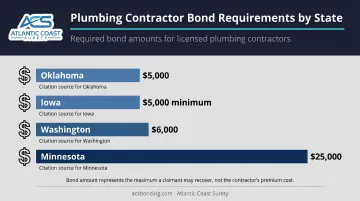
Bond amounts — the face value of the bond, not what you pay — are set by the obligee and vary considerably by jurisdiction. Here are verified examples from official sources:
| State | Required Bond Amount | Source |
|---|---|---|
| Washington | $6,000 | Washington L&I |
| Oklahoma | $5,000 | Oklahoma Construction Industries Board |
| Iowa | $5,000 minimum | Iowa DIAL |
| Minnesota | $25,000 | Minnesota DLI |
New York City and Westchester County are worth noting as counterexamples: both jurisdictions focus primarily on insurance requirements rather than fixed bond amounts for plumbing contractors. NYC Master Plumbers must maintain $1,000,000 CGL per occurrence in liability insurance coverage.
Where Bond Requirements Come From
Bond requirements can originate at three different levels:
- State level — Washington and Oklahoma both have state-mandated bond amounts
- County level — Westchester County sets its own plumbing licensing requirements
- City/municipality level — NYC DOB issues its own Master Plumber license with separate requirements
In some cases, all three levels apply simultaneously. Relying on the state board's website alone will leave gaps — always verify county and municipal requirements for each jurisdiction where you work.
In Washington, a general construction contractor registered under RCW 18.27 who also performs plumbing work must maintain a separate plumbing contractor bond — the general contractor bond does not satisfy both requirements.
Bond lapses carry immediate consequences worth understanding. In Washington, cancellation or expiration of a bond or insurance automatically suspends the plumbing contractor license. Reinstatement requires proof the issue is corrected plus a $69.50 reinstatement fee. Oklahoma similarly renders the license inactive if insurance requirements aren't current.
How Much Does a Plumbing Contractor License Bond Cost?
The bond amount listed by the licensing authority (e.g., $5,000 or $6,000) is the maximum payout available to claimants — not what the contractor pays. You pay a bond premium, which is a percentage of the total bond amount.
To illustrate: a $6,000 bond with a 2% premium rate would cost approximately $120 per year.
Actual premium rates depend on underwriting, and NASBP notes that surety pricing reflects financial capacity, creditworthiness, net worth, and cash flow — not a flat national rate.
Key Factors That Influence Your Premium
- Credit score — the primary driver; stronger credit generally means lower premiums
- Bond amount required — higher bond amounts typically produce higher total premiums
- State and license type — some jurisdictions carry different underwriting risk profiles
- Claims history — prior bond claims will increase your rate
Contractors with challenged credit can still obtain bonding, but typically at higher premium rates through specialty surety markets. Atlantic Coast Surety is a bond-only agency with 20+ years placing contractor compliance bonds through A-rated, T-listed carriers in both standard and specialty markets. Working with a specialist means plumbing contractors get matched to the right carrier for their credit profile and receive bonding-specific guidance rather than general insurance advice.
How to Get Your Plumbing Contractor License Bond
The process is straightforward when you know what to gather:
- Confirm the exact bond amount and obligee — check with your specific state board, county, or city licensing authority (not third-party websites)
- Contact a licensed surety bond agency and submit a quote request with your company information, tax ID, and owner details
- Undergo a credit review — soft or hard pull depending on bond type and amount
- Receive your bond quote and review the premium amount
- Pay the premium and receive your bond document
- Submit the bond to the licensing authority along with your contractor license application, naming them as the certificate holder if required
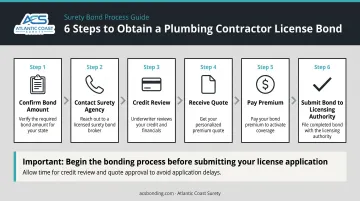
Timing matters. Once you've worked through those steps, note that the bond must typically be in place before a license is issued or renewed. Starting the bonding process before submitting your full license application avoids delays that could push back your start date by weeks.
If you work with an insurance agent or broker, they can access contractor bonding programs through Atlantic Coast Surety — a wholesale surety bond broker that works exclusively with agents, not directly with contractors. Because surety bonds are their only line of business, the team handles documentation requirements, certificate holder naming, and carrier matching in-house, which means your agent gets clear answers without bouncing between departments.
Frequently Asked Questions
Do plumbers need to be bonded?
Most states require plumbing contractors — those running their own plumbing business — to hold a surety bond as part of their contractor license. Journeyman and apprentice plumbers working under a licensed contractor typically do not need their own bond.
How much does a plumbing contractor license bond cost?
You pay a premium — a percentage of the required bond amount — based primarily on your credit score. State-required bond amounts typically range from $5,000 to $25,000 depending on jurisdiction, with annual premiums generally falling between 1% and 15% of that amount.
What is the difference between a plumbing contractor bond and plumbing insurance?
A bond protects third parties (clients and regulators) if the contractor violates licensing obligations or fails to perform work as agreed. Liability insurance protects the contractor's business from accidents, injuries, or property damage claims. Most licensing authorities require both, and they cannot substitute for each other.
What happens if a claim is filed against my plumbing contractor bond?
The surety investigates the claim and may pay damages up to the bond amount to the affected party. The contractor is then legally obligated to reimburse the surety: the bond functions like a guaranteed line of credit for claimants, not a free safety net.
Can I get a plumbing contractor bond with bad credit?
Yes, but expect a higher premium. Working with an agency that has access to specialty surety markets improves your odds of approval and can help you secure better rates even with a limited or poor credit history.
How long does a plumbing contractor license bond last?
Most plumbing contractor bonds are issued annually and must be renewed in line with your license term. In Washington, a lapsed bond triggers automatic license suspension. Set a renewal reminder at least 60 days before your expiration date to avoid an interruption in your license.