
Introduction
Nebraska's contractor bonding rules trip up contractors regularly. Unlike most states, Nebraska doesn't impose a bond requirement at the state registration level. The Nebraska Department of Labor only requires workers' compensation insurance and a $25 annual fee to register. That's it.
That doesn't make bonding optional. Most Nebraska cities and counties require a contractor license bond as part of their local licensing process — and the amounts, requirements, and obligees vary by jurisdiction. A contractor working in Omaha and Lincoln simultaneously may need two separate bonds meeting each city's distinct requirements.
This guide covers how the bond mechanism works, what amounts are required in Omaha, Lincoln, Blair, and La Vista, how public construction thresholds apply, and how to get bonded efficiently.
TL;DR
- Nebraska's state DOL registration requires no bond — only workers' comp insurance and a $25 fee
- Bond requirements come from city and county licensing authorities, not the state
- Omaha requires a $10,000 bond for all building contractor license classes (A–E); master electricians seeking bonded status need $12,500
- A license bond protects the public and licensing authority; any paid claim must be reimbursed to the surety by the contractor
- Straightforward license bonds can often be issued within one to two business days
What Is a Nebraska Contractor License Bond — and When Is It Required?
A contractor license bond is a three-party agreement between the principal (the contractor), the surety company, and the obligee (typically a city, county, or project owner). The surety guarantees to the obligee that the contractor will fulfill their licensing obligations. If they don't, the obligee can file a claim against the bond.
How It Differs from Insurance
A bond is not designed to protect the contractor. It protects the obligee and the public. If a claim is paid out, the surety pursues the contractor for full reimbursement. It functions more like a credit instrument than a liability policy: the contractor remains ultimately liable.
When Is a Bond Required in Nebraska?
Nebraska has two distinct licensing tiers:
| Level | Authority | Bond Required? |
|---|---|---|
| State DOL Registration | Nebraska Department of Labor | No — only workers' comp + $25 fee |
| Local Contractor License | City or county licensing department | Yes — in most jurisdictions |
Contractors working across multiple counties may need a separate bond for each jurisdiction. Registering with the DOL does not satisfy local bond requirements.
Types of Bonds Nebraska Contractors Encounter
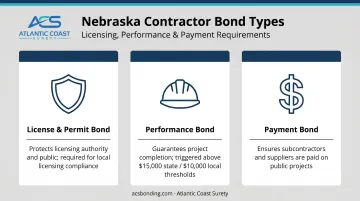
- License and permit bonds — required for local licensing compliance; protects the licensing authority and public
- Performance bonds — guarantees project completion on public contracts over $15,000 (state) or $10,000 (local government)
- Payment bonds — ensures subcontractors and suppliers are paid on public projects
How a Nebraska Contractor License Bond Works
The Bonding Mechanism
The process works in three steps:
- The contractor pays a premium to the surety company
- The surety issues the bond, promising the obligee that the contractor will comply with licensing conditions
- The bond stays active as long as the contractor renews it annually
The Claims Process
Who can file a claim depends on the bond type. For license and permit bonds, harmed clients or the licensing authority typically have standing. For payment bonds on public projects, subcontractors and suppliers who furnished labor or materials can pursue claims under Nebraska Revised Statute 52-118.01.
What triggers a valid claim:
- Contractor default or project abandonment
- Failure to comply with license conditions
- Non-payment to subcontractors or suppliers
After a claim is filed, the surety investigates. If valid, it pays the obligee up to the bond amount, then seeks reimbursement from the contractor. Unlike insurance, the contractor is ultimately responsible for repaying any claim the surety covers.
Public Construction Performance and Payment Bonds
On Nebraska public projects, performance bonds require the surety to step in and arrange for project completion if the prime contractor fails. Payment bonds allow subcontractors and suppliers with a direct contract with the prime contractor to seek payment.
A subcontractor who has a contract with a sub — but not directly with the prime contractor — must provide written notice to the prime contractor within four months of last performing work before filing a payment bond claim.
Public projects follow statutory rules, but private construction projects operate differently. On private jobs, bond claim rights are governed by the specific bond document terms, not statute. Contractors and subcontractors should obtain and review the bond before starting work.
Nebraska Contractor Bond Amount Requirements by Jurisdiction
Nebraska Revised Statute 52-118 imposes no bond requirement at the contractor registration level. Every bond amount mandate comes from individual municipalities and counties.
Omaha (Douglas County)
The City of Omaha licensing page lists bond requirements for all building contractor license classes:
| License Class | Required Bond Amount |
|---|---|
| Class A, B, C, D, E | $10,000 minimum |
| Master Electrician (Bonded) / Electrical Contractor | $12,500 minimum |
Bond documents are submitted directly to city department contacts. Always confirm the current required bond form with the City of Omaha Planning Department before purchasing.
Lincoln (Lancaster County)
Lincoln's requirements are tied to specific work types and locations. The City of Lincoln Building and Safety Department publishes the following confirmed requirements:
- Right-of-way work (excavation, sign, street use permits): $5,000 license and permit bond, renewable annually, with the City of Lincoln as obligee
- Fire sprinkler work with underground piping in the public way: $5,000 payment bond required for master plumber contractors before permit issuance
For HVAC, electrical, and general plumbing contractors, requirements vary based on work type and right-of-way involvement — confirm directly with the Building and Safety Department.
Other Nebraska Jurisdictions
| City | Contractor Types | Bond Amount |
|---|---|---|
| Blair | Electrical, plumbing, mechanical contractors; water service line installers; drain layers; tree trimmers | $5,000 (City of Blair named as obligee) |
| La Vista | Mechanical/steamfitter contractors; plumbing/tile layer contractors | $5,000 |
| South Sioux City | Various contractor and master trade categories | Confirm directly with city |
Bond amounts and requirements change — verify current figures with the relevant local authority before applying.
Public Construction Projects
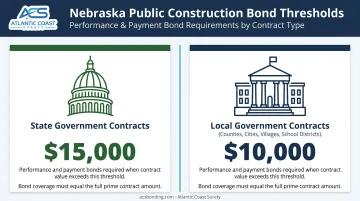
State statute sets clear thresholds:
- State government contracts: Performance and payment bonds required when total contract value exceeds $15,000
- Local government contracts (counties, cities, villages, school districts): Required when total contract value exceeds $10,000
- Bond coverage: Must equal at least the full prime contract amount
Below these thresholds, bonds are not legally required — but some public entities may still request them contractually.
How to Get a Nebraska Contractor License Bond
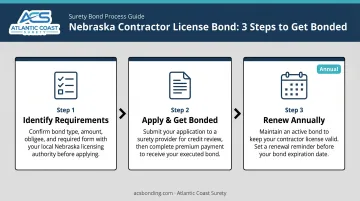
Step 1: Identify the Exact Bond Required
Before contacting any surety provider, call the city or county licensing department where you intend to work. Confirm:
- Bond type (license and permit bond, performance bond, or payment bond)
- Required bond amount
- Named obligee
- Whether a specific bond form is required
Buying the wrong amount or naming the wrong obligee (even with the correct bond type) will not satisfy the licensing requirement.
Step 2: Apply Through a Qualified Surety Provider
Once you know exactly what's needed, submit an application to a licensed surety company or bond-only agency. What the underwriting process looks like depends on the bond:
For smaller license and permit bonds ($5,000–$10,000):
- Typically requires basic business and owner information
- Credit checks are generally not required at these amounts
- Often processed quickly — sometimes within one to two business days
For larger public construction performance bonds:
- Requires comprehensive financial documentation: three years of CPA-prepared financial statements, personal financial statements, recent bank statements, and corporate tax returns
- Contractor questionnaire covering work history, key personnel, largest prior contracts, and bonding history
- Full underwriting review — expect a longer timeline
Need help placing a Nebraska contractor bond? Atlantic Coast Surety is a bond-only agency with 20+ years of experience working with contractors on both standard and specialty programs. The firm places bonds through A-rated, T-listed carriers. Contact the team at aspina@acsbonding.com or call (201) 661-2381.
Step 3: Pay the Premium and Maintain the Bond
The premium is a percentage of the bond amount — not the full amount. For performance and payment bonds, NASBP data indicates premiums typically range from 1% to 3% of the contract value, though the rate depends primarily on credit history, financial strength, and project risk.
For smaller license bonds, the rate per dollar is typically higher, but the total premium cost stays low given the smaller bond amounts involved.
Key renewal reminders:
- Most license bonds require annual renewal
- The bond must remain active for the license to stay valid
- A lapsed bond can result in license suspension — set a renewal reminder before the expiration date
Common Misconceptions About Nebraska Contractor Bonds
Several widespread assumptions lead Nebraska contractors into compliance gaps. These three come up most often:
Misconception 1: State DOL registration covers bonding requirements. The Nebraska Contractor Registration Act requires no bond. Contractors who register at the state level and assume they're fully compliant may still be violating local licensing requirements in every city or county where they work.
Misconception 2: A bond works like liability insurance. A bond is a credit instrument, not a loss-absorbing policy. The surety pays a valid claim, then pursues the contractor for full reimbursement. Misunderstanding this distinction creates serious financial exposure that most contractors don't anticipate until a claim lands.
Misconception 3: One bond covers all Nebraska jurisdictions. A bond issued for Omaha doesn't satisfy Lincoln's requirements — and vice versa. Contractors working across multiple jurisdictions often need separate bonds, each meeting the specific obligee, amount, and form requirements of that city or county.
Frequently Asked Questions
How do Nebraska contractor license bonds work?
A contractor license bond is a three-party agreement: the surety guarantees to the obligee (city or county licensing authority) that the contractor will meet licensing obligations. If a valid claim is filed and paid, the contractor is legally required to reimburse the surety for the full amount paid.
Is a bond required to register as a contractor with the Nebraska Department of Labor?
No. The Nebraska Contractor Registration Act only requires workers' compensation insurance (for contractors with one or more employees) and a $25 annual registration fee. Bond requirements are imposed separately at the city and county level.
What types of bonds can be required from a Nebraska contractor?
Three main types: license and permit bonds (required for local licensing compliance), performance bonds (required on public construction contracts above the statutory $15,000 state or $10,000 local threshold), and payment bonds (protecting subcontractors and suppliers on public projects).
How much does a Nebraska contractor license bond cost?
Premiums typically run 1%–3% of the required bond amount, based on the contractor's credit score and financial history. For a $10,000 Omaha bond, well-qualified applicants generally pay $100–$300 annually, with higher-risk applicants toward the top of that range.
How long does it take to get a Nebraska contractor license bond?
Most license bonds, including the standard $10,000 Omaha building contractor bond, can be issued within one to two business days of a completed application. Larger performance bonds for public projects require full underwriting and take longer based on documentation needs.
How do I obtain a contractor performance bond in Nebraska?
Determine the required bond amount and obligee from the contracting public entity, then apply through a licensed surety provider. The underwriting process covers financials, credit, and project experience. For public contracts, bond coverage must equal at least the full contract price under Nebraska statute.