This guide covers the core mechanics of surety bonds, when Vermont contractors actually need them, which bond types apply to which situations, what they cost, and how they differ from the liability insurance Vermont's registration program requires.
Key Takeaways
- Vermont's residential contractor registration (required for projects $10,000+) requires liability insurance , not a surety bond
- VTrans transportation contracts under 19 V.S.A. § 10 require performance and payment bonds; surety requirements may be waived for contracts of $100,000 or less
- Each BGS solicitation carries its own bonding requirements — review bid documents individually before submitting
- Bid bonds on Vermont public projects are typically 5% of the bid amount; performance and payment bonds vary by contract
- Bond premiums generally run 0.5%–3% of the bond's face amount, based on credit history and financial strength
- Bonds protect the project owner; insurance protects the contractor — two distinct tools with different purposes
What Is a Vermont Contractor License Bond?
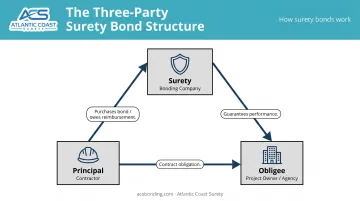
The Three-Party Structure
A surety bond involves three parties:
- Principal — the contractor purchasing the bond
- Obligee — the project owner or government agency protected by the bond
- Surety — the bonding company that guarantees the contractor's performance
If the contractor fails to meet their obligations, the obligee can file a claim against the bond for financial recovery up to the bond's penal sum.
Unlike insurance, the surety retains the right to seek full reimbursement from the contractor after paying a claim. A bond is a guarantee of performance — not a loss-pooling arrangement.
Where Bond Obligations Come From in Vermont
Vermont contractors encounter bonding requirements from three distinct sources:
- State licensing statutes — some trade license categories carry bond conditions specific to that classification
- Vermont public procurement law — VTrans transportation contracts under 19 V.S.A. § 10 require bonds; BGS solicitations carry their own project-specific bonding terms
- Private contractual requirements — project owners, lenders, and general contractors may require bonds as a condition of the contract
A Note on Federal Requirements
Beyond those three sources, contractors working on federally funded projects in Vermont face an additional, independent layer of obligations. Under the Miller Act (40 U.S.C. § 3131), performance and payment bonds are required on federal construction contracts. The current Federal Acquisition Regulation threshold is contracts exceeding $150,000. These requirements operate independently of Vermont state rules — both frameworks apply simultaneously on covered federal projects.
Is a Surety Bond Required for Vermont Contractors?
Residential Contractor Registration: No Bond Required
Vermont's residential contractor registration — administered by the Secretary of State's Office of Professional Regulation — does not require a surety bond. Contractors registering for residential projects valued at $10,000 or more must provide:
- Proof of general liability insurance ($1 million per occurrence / $2 million aggregate)
- Registration fee ($75 for individuals, $250 for business organizations)
This is a common point of confusion. The financial protection mechanism for residential registration is liability insurance, not a bond. The SOS FAQ states explicitly that a surety bond is not required.
Public Works: Bonds Are Required
Vermont public works contracts operate under different rules. For VTrans transportation-improvement projects, 19 V.S.A. § 10 (amended effective May 13, 2025) requires contractors to file:
- A surety bond guaranteeing contract compliance
- An additional bond protecting labor, material suppliers, and other claimants
The Secretary may waive these requirements for contracts of $100,000 or less. For BGS construction solicitations, bonding requirements vary by project and are detailed in the BGS Construction Invitation to Bid template (revised November 2025) includes bonding fields, but requirements vary by project. Review the Instructions to Bidders for each solicitation.
Contractual and Voluntary Bonding
Even when no statute requires a bond, private owners, construction lenders, and general contractors frequently impose bonding requirements through contract terms. These clauses are fully enforceable. Review every project agreement carefully before signing.
Some Vermont contractors also carry bonds voluntarily. For those competing on high-value residential projects, being bonded offers concrete advantages:
- Signals financial stability to owners and lenders
- Demonstrates professionalism that distinguishes you from unbonded competitors
- Can be the deciding factor when a general contractor is selecting subs
Types of Surety Bonds Vermont Contractors Encounter
Bid Bonds
A bid bond guarantees the contractor will execute the contract at the quoted price if awarded. If the contractor withdraws or fails to sign, the surety pays the difference between their bid and the next lowest responsive bid, up to the bond penalty.
On Vermont public projects, bid bonds are typically set at 5% of the bid amount — as reflected in VTrans solicitation documents, including the 2024 Readsboro BF 0102(16) invitation. This is a solicitation-based practice, not a fixed statutory percentage.
Performance Bonds
Performance bonds protect the obligee against losses from contractor non-completion or defective work. On federal contracts, the bond amount is typically set at 100% of the contract price under FAR clause 52.228-15. For Vermont state contracts, the amount is set by the relevant agency based on the specific project.
VTrans requires performance bonds to be executed by a surety authorized to transact business in Vermont — contractors can verify authorization through the Vermont Department of Financial Regulation.
Payment Bonds
Payment bonds accompany performance bonds on public contracts, guaranteeing that subcontractors, laborers, and material suppliers get paid. On private projects, they serve as an alternative protection mechanism where mechanic's lien rights might otherwise apply.
For VTrans contracts, 19 V.S.A. § 10 requires both a performance-type bond and a separate labor/material claimant bond. Key compliance details:
- Both bonds must be filed for VTrans contracts under 19 V.S.A. § 10
- Claimants have 90 days from final project acceptance to file a sworn statement with the Secretary
License and Specialty Trade Bonds
Certain Vermont trade categories — electricians, plumbers, and other specialty contractors regulated by the Department of Public Safety Division of Fire Safety — may carry bond requirements specific to their license category. No universal bond requirement appears in DFS regulations, but requirements vary by trade. Verify requirements directly with the relevant licensing board.
How Much Does a Vermont Contractor Bond Cost — and How Do You Get One?
How Premiums Are Calculated
Bond premiums are a percentage of the bond's face amount (penal sum), not the contract value. According to NASBP's 2024 surety bond guide, performance bond premiums typically run between 0.5% and 3% of the bond amount.
A straightforward example: on a $50,000 performance bond at a 1% premium rate, the contractor pays $500 for the bond. At 2%, that's $1,000. The specific rate depends entirely on underwriting outcomes.
What Drives Your Rate
Sureties evaluate several factors when setting premium rates:
- Credit score — a primary underwriting factor
- Financial statements — typically three years of CPA-prepared corporate financials
- Work in progress — both bonded and unbonded jobs currently underway
- Years in business — longer track records generally support better rates
- Claims history — prior losses weigh heavily in underwriting decisions
- Largest completed contracts — demonstrates capacity for the requested bond amount
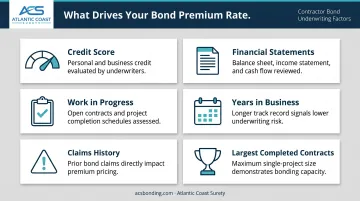
Strong credit and clean financials typically produce rates at the lower end of the range. Poor credit doesn't automatically disqualify a contractor — specialty surety markets exist for harder-to-place risks, though rates will be higher.
Working With Atlantic Coast Surety
Atlantic Coast Surety is a bond-only agency with 20+ years of experience and access to A-rated, T-listed surety providers through both standard and specialty markets. In-house underwriting authority — built through direct carrier relationships over two decades — means submissions don't get routed through an extra layer before a decision is made.
Note: Atlantic Coast Surety operates as a wholesale broker, meaning Vermont contractors access their services through a retail insurance agent or broker. Your agent submits the application; Atlantic Coast Surety handles the underwriting and placement.
What's required depends on bond size:
- Compliance bonds ($50,000 or less): Basic company and owner information; credit check required above $25,000
- Performance and payment bonds: Full contractor questionnaire, three years of financials, work-in-progress schedules, and bank statements
Your retail agent can contact Atlantic Coast Surety directly to start the submission process.
Contractor Bond vs. Contractor Insurance: Key Differences
Contractors often confuse these two products — and that confusion can leave real gaps in their compliance setup.
| Surety Bond | General Liability Insurance | |
|---|---|---|
| Who it protects | The obligee (project owner, agency) | The contractor |
| Reimbursement | Yes — surety recovers from contractor after paying a claim | No — insurer absorbs the covered loss |
| What triggers a claim | Contractor fails to perform or pay | Third-party bodily injury or property damage |
| Required for Vermont registration | No | Yes ($1M per occurrence / $2M aggregate) |
Vermont's residential contractor registration requires insurance, not a bond. But both can be part of a contractor's complete compliance and credibility profile — especially for public works or large commercial contracts where bonds are required.
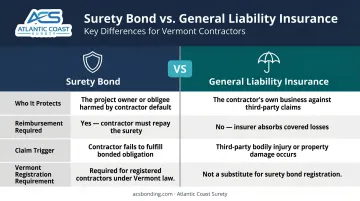
The most critical distinction: when an insurer pays a claim, that's the end of it for the contractor. When a surety pays a bond claim, the contractor owes the surety that money back. Knowing the difference upfront helps contractors budget accurately and avoid surprises if a claim is ever filed.
Frequently Asked Questions
Does Vermont require contractors to carry a surety bond?
Vermont's residential contractor registration requires liability insurance, not a surety bond. Bonds become mandatory for VTrans transportation contracts — with a waiver option available for contracts of $100,000 or less — and for BGS solicitations that include bonding requirements. Private contracts may also require bonds regardless of state law.
What is the difference between a contractor bond and contractor insurance in Vermont?
Insurance protects the contractor — the insurer absorbs covered losses without seeking repayment. A surety bond protects the project owner or obligee, and if the surety pays a claim, the contractor must reimburse the surety. They protect different parties and work through entirely different financial mechanisms.
How much does a contractor surety bond cost in Vermont?
Premiums typically run 0.5%–3% of the bond's face amount, with the exact rate determined by underwriting factors including credit score, financial statements, claims history, and work-in-progress schedules. Speak with a surety specialist for a specific quote based on your financial profile and bond requirements.
What types of surety bonds are required on Vermont public works projects?
VTrans transportation contracts under 19 V.S.A. § 10 require a performance bond and a separate labor/material claimant bond. Bid bonds are commonly set at 5% of the bid amount on VTrans solicitations. BGS projects include project-specific bonding requirements in their solicitation documents.
What happens when a claim is filed against a contractor's bond in Vermont?
The obligee submits a claim to the surety, which investigates and — if the claim is valid — pays up to the bond's penal sum. The surety then seeks reimbursement from the contractor. For VTrans labor/material bonds, claimants must file within 90 days of final project acceptance.
Do subcontractors in Vermont need to be bonded?
Vermont law does not universally require subcontractor bonding. However, general contractors on public or large commercial projects routinely flow bond requirements down to critical subcontractors through their subcontracts — making the general contractor the obligee and the subcontractor the principal on those bonds.