This guide covers when bonds are required, what each type does, what they cost, and how to get one.
Key Takeaways
- Maine has no universal surety bond requirement for all contractors and no statewide home improvement contractor (HIC) registration bond
- Public works contracts above the applicable threshold require performance and payment bonds under Title 14 §871 — each equal to the full contract amount
- Home construction contracts above the applicable minimum require written agreements and deposit limits under Title 10 §1487
- LD 1226 — which proposed residential licensing starting January 1, 2027 — died on adjournment on April 29, 2026 and is not current law
- Bond premiums are a percentage of the contract amount; you pay the premium, not the full bond amount
What Is a Maine Contractor License Bond?
A surety bond is a three-party agreement between:
- The principal — the contractor who purchases the bond
- The obligee — the party protected by the bond (a state agency, municipality, or project owner)
- The surety — the bonding company that guarantees the principal's obligations
The Surety & Fidelity Association of America defines it as a written agreement to guarantee performance or payment of another's obligation under a contract or in compliance with law or regulation.
A Bond Is Not Insurance
General liability insurance protects against third-party bodily injury and property damage claims. A surety bond is a financial guarantee that you'll fulfill specific contractual or statutory obligations. The two serve entirely different purposes.
The critical difference: if the surety pays a bond claim, you must reimburse the surety in full. There's no spreading of risk the way insurance works. Maine procurement documents consistently treat bonds and insurance as separate requirements — you typically need both.
When Are Contractor Bonds Required in Maine?
Public Works Contracts (Title 14 §871)
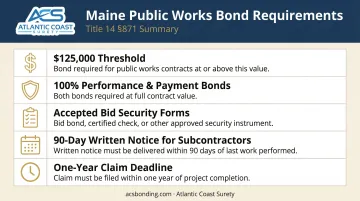
Maine's Public Works Contractors' Surety Bond Law sets a clear threshold: any public construction, alteration, or repair contract exceeding the applicable statutory threshold — awarded by the state, a political subdivision, or a public authority — requires the contractor to furnish both a performance bond and a payment bond.
Key statutory details from Title 14, Section 871:
- Both bonds must equal the full contract amount
- Bid security may be required at the contracting authority's discretion — acceptable forms include a surety bid bond, certified check, cashier's check, money order, or certificate of deposit
- An irrevocable letter of credit from a qualifying financial institution may substitute for performance or payment bonds at the contracting authority's discretion
- Subcontractors and suppliers without a direct contract with the prime must file written notice within 90 days of their last work or delivery to preserve payment bond claims
- Actions on the payment bond are generally limited to one year from the date labor was last performed or materials supplied
For federal public contracts, a separate law applies: the Miller Act requires performance and payment bonds on construction contracts exceeding the federal threshold, per FAR 28.102-1.
Home Construction Contracts (Title 10 §1487)
Maine's Title 10, Section 1487 establishes consumer protections for residential work — but what it requires and what it doesn't are two distinct things.
The statute requires:
- A written contract signed by both parties for any home construction contract exceeding the applicable minimum in materials or labor
- Deposit limits capped at one-third of the total contract price unless the homeowner agrees in writing to an exemption
- An express workmanship warranty covering faulty materials, code compliance, skillful construction, and fitness for habitation
What the statute does not create — based on a review of official OPOR sources — is a verified statewide HIC registration bond requirement with a specific bond amount or OPOR filing process. The Maine Attorney General's office confirms the written-contract rules but does not reference a surety bond mandate for general residential contractors.
Contractors should contact OPOR directly to confirm any current bond requirements before assuming none apply.
Municipal-Level Requirements
State-level bond requirements set the floor — many Maine municipalities add their own requirements on top.
Official reviews of Portland, Bangor, and Lewiston found no general contractor license bond at the city level — but Lewiston's public works bid documents (Bid No. 2025-059) confirm project-specific bid security and performance/payment bond requirements for municipal construction contracts.
The takeaway: contact the code enforcement office or city clerk in every municipality where you operate. Requirements vary significantly and won't always appear on a general business licensing page.
Types of Contractor Bonds in Maine
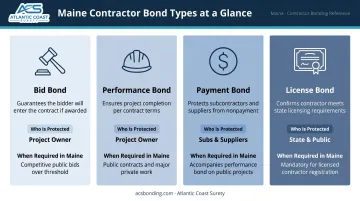
| Bond Type | Purpose | Who Is Protected | When Required in Maine |
|---|---|---|---|
| License/Registration Bond | Guarantees compliance with statutes and licensing terms | Consumers, state agency | Municipal requirements; verify with OPOR for any state-level mandates |
| Performance Bond | Guarantees project completion per contract terms | Project owner / public entity | Required on public works contracts over the applicable state threshold |
| Payment Bond | Guarantees payment to subs, labor, and material suppliers | Subcontractors, suppliers | Required alongside performance bond on qualifying public works contracts |
| Bid Bond | Guarantees contractor will execute contract and provide bonds if awarded | Contracting authority | Discretionary on Maine public works bids; required when specified |
Before selecting a bond type, three points that affect cost and compliance:
- Performance and payment bonds are nearly always required together on Maine public works projects — the statute mandates both
- Bid bonds and payment bonds often come at no additional cost when packaged with a performance bond from the same surety
- License and permit bonds are a separate commercial surety category — relevant if a municipality or future state program requires one for registration
How Much Does a Maine Contractor Bond Cost?
You pay a premium — a percentage of the total bond amount (called the penal sum) — not the full bond amount itself. The penal sum is what the surety would pay on a valid claim.
Premium Rate Ranges
Based on data from NASBP and Merchants Bonding Company:
- Standard contractors: competitive rates based on underwriting factors
- Small or emerging contractors: higher rates based on underwriting factors
- Sureties typically include payment bonds and bid bonds at no additional charge when packaged with a performance bond
What Drives Your Rate
| Factor | Impact |
|---|---|
| Credit score | Strongest single factor; better credit means a lower rate |
| Bond amount required | Larger bonds may qualify for lower percentage rates |
| Bond type | License bonds vs. performance bonds price differently |
| Years in business | Established contractors with track records get better terms |
| Prior bond claims | Claims history raises rates and may narrow market access |
| Financial strength | Revenue, working capital, and net worth all factor in |
Illustrative Cost Example
For a public works contract, the performance bond must equal the full contract value. The premium you pay depends on your credit profile and underwriting factors:
- Contractor with strong credit: a lower annual premium as a percentage of the bond amount
- Smaller or newer contractor: a higher annual premium as a percentage of the bond amount
The bond amount is set by the obligee and non-negotiable. Your rate, however, is where there's room to work. Agencies with access to both standard and specialty markets can shop your profile across multiple carriers to find competitive pricing.
Atlantic Coast Surety works through insurance agents and brokers to place bonds with A-rated, Treasury-listed carriers. For contractors with non-standard credit profiles, specialty surety markets remain an option — though those programs carry higher premiums to offset the added risk.
How to Get a Contractor Bond in Maine
The process follows a straightforward sequence:
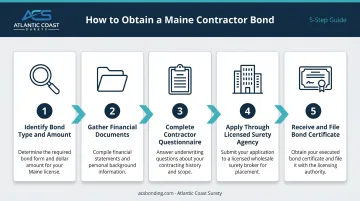
- Identify the bond type and amount required — check contract documents for public works projects, or contact OPOR and your local municipality for any license/registration requirements
- Gather financial documents — for performance and payment bonds, expect to provide CPA-prepared three-year financial statements, personal financial statements, three months of bank statements, and your most recent corporate tax return
- Complete a contractor questionnaire — surety underwriters want your contracting specialty, years in business, key personnel details, bonding history, largest contracts on hand, and revenue projections
- Apply through a licensed surety bond agency — for performance/payment bonds, also submit bid results including second and third low bidders, plus your current work-in-progress figures (bonded and unbonded)
- Receive the bond certificate — file with OPOR if required for a license bond, or submit as part of the contract package for public works
Understanding what underwriters look for helps you prepare a stronger application from the start.
What Underwriters Evaluate
According to NASBP and Old Republic Surety, underwriters look at:
- Personal and business credit history
- Financial strength (net worth, cash flow, working capital)
- Work history and experience with similar contract types
- Technical ability and managerial skill
- Banking relationships and reputation for meeting obligations
One practical note on timing: surety bond underwriting involves credit review and financial analysis. The process resembles a mortgage application more than buying a standard insurance policy. Once a surety establishes a bond line for your firm, subsequent bonds move through approval faster — often within a day or two for routine requests.
Maine LD 1226: What Contractors Need to Know
LD 1226, officially titled "An Act to Protect Consumers by Licensing Residential Building Contractors," generated significant attention in the Maine construction industry. Here's the accurate picture.
What the Bill Proposed
The original bill text proposed:
- A state license requirement for residential construction projects with a contract price exceeding the applicable minimum
- Application and renewal fees as set by the licensing authority
- Evidence of the required aggregate general liability insurance and workers' compensation coverage
- Civil fines as set by applicable law for intentional violations
- Loss of mechanic's lien rights for unlicensed work
- Classification of violations as unfair trade practices under Title 5, Section 207
The bill text contained no explicit surety bond requirement.
What Actually Happened
The bill died on adjournment on April 29, 2026. It is not enacted law. The January 1, 2027 licensing date was a proposal, not a deadline that currently applies.
As of now, Maine's Attorney General confirms that general contractors, roofers, and framing contractors are not state licensed or regulated in Maine. OPOR's specialty licensing boards cover electricians, plumbers, and fuel technicians — not general construction.
What Contractors Should Do Now
Even though LD 1226 failed, similar legislation is likely to resurface. Legislative pressure for residential contractor licensing in Maine remains strong. Contractors who are already bonded and financially documented will be better positioned if a successor bill passes.
Getting bonded before a deadline exists also means you have time to shop markets, compare rates, and satisfy underwriting requirements without pressure.
Frequently Asked Questions
How much is a surety bond in Maine?
The cost depends on bond type, the required bond amount, and your credit and financial profile. For performance bonds, premiums are a percentage of the total bond amount annually. A surety broker can provide an exact quote once they know your project size and bond type.
What are the three types of bonds that can be required from a contractor?
The three most common contractor bonds are:
- Bid bond — guarantees you'll execute the contract if awarded
- Performance bond — guarantees project completion per contract terms
- Payment bond — guarantees payment to subcontractors and material suppliers
A license or registration bond is a fourth type, required where state or municipal registration mandates one.
Does a contractor have to be licensed in Maine?
Currently, only electricians, plumbers, and fuel technicians require a state license. General contractors do not need a statewide license — LD 1226, which would have changed that for residential work above a certain threshold, died in the 2026 legislative session.
When is a surety bond required for contractors in Maine?
The clearest trigger is public works: contracts above the applicable threshold require performance and payment bonds under Title 14 §871. Some municipalities may require bonds for local contractor registration. Check directly with OPOR and your local code enforcement office for any current registration bond requirements.
What is the difference between a contractor bond and contractor insurance in Maine?
Insurance covers third-party bodily injury and property damage losses — the insurer absorbs the risk. A surety bond is a financial guarantee that you'll fulfill your contractual or statutory obligations, and if the surety pays a claim, you're legally required to reimburse them in full. Maine contractors typically need both, but they serve separate purposes.