Introduction
Idaho takes a deliberately targeted approach to contractor bonding. Unlike neighboring Oregon — where residential general contractors need a bond at the required state amount — or Washington, which requires a bond for general contractors at the required state amount since July 2024, Idaho does not mandate a surety bond for all contractors at the state level.
Specific licensed trades, however, must carry one. Miss this requirement and you risk losing your license, your ability to pull permits, and your right to collect payment through the courts.
This guide walks Idaho specialty contractors through what a contractor license bond is, which trades must have one, what it costs, and how to get bonded.
TLDR: Key Takeaways
- Idaho only requires bonds for specific trades — plumbing, HVAC/mechanical, fire protection sprinkler, and farm labor contractors
- Most specialty contractor bonds are set at the state-required amount; farm labor bonds require a larger amount based on employee count
- You pay a premium based on a fraction of the bond amount; your credit score is the primary factor in determining the rate
- General contractors are not bonded at the state level, but local municipalities may have separate requirements
- A surety bond protects clients and the state — it is not insurance for the contractor
What Is an Idaho Contractor License Bond?
A contractor license bond is a three-party agreement involving:
- The principal — the contractor purchasing the bond
- The obligee — the Idaho licensing authority (such as DOPL or the Idaho Department of Insurance)
- The surety — the bond provider guaranteeing the contractor's obligations
According to the Surety & Fidelity Association of America (SFAA), a surety bond is a written agreement in which the surety guarantees to the obligee that the principal will perform according to the bond, statute, or contract.
Surety Bond vs. General Liability Insurance
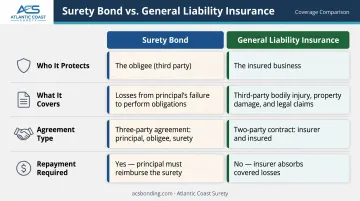
Many contractors confuse the two. They are not the same thing:
| Surety Bond | General Liability Insurance | |
|---|---|---|
| Who it protects | Clients and the state | The contractor |
| What it covers | Failure to comply with laws or obligations | Accidental losses and damage |
| Agreement type | Three-party | Two-party |
| Repayment required | Yes — contractor repays the surety | No |
What Happens When a Claim Is Filed
If a client or the state suffers financial harm because a contractor violated licensing rules or abandoned a project, they can file a claim against the bond. The surety investigates and may pay the claimant up to the full bond amount.
The contractor must then reimburse the surety. This is why a bond functions as a guarantee of performance, not a safety net. Contractors who generate claims face both reimbursement liability and potential license consequences.
That reimbursement risk is exactly why Idaho mandates bonds for specific trades — faulty plumbing, unsafe HVAC work, or improperly installed fire suppression systems can cause serious harm. A bond creates financial accountability that a registration requirement alone cannot provide.
Which Idaho Contractors Are Required to Have a License Bond?
Bond requirements in Idaho vary significantly by contractor type — some trades carry mandatory surety bonds while others don't. Here's how each category breaks down.
General Contractors
General contractors registering with DOPL under the Idaho Contractor Registration Act are not required to carry a state-level surety bond. The state requires:
- Proof of general liability insurance at the minimum required limit
- Workers' compensation coverage or an exemption statement
- Registration for any non-exempt construction work above the applicable registration threshold
A homeowner or purchaser may request a bond at their own expense, but the state doesn't require one.
Plumbing Contractors
Plumbing contractors must submit a surety bond at the required amount as part of their DOPL license application under Idaho Code Title 54, Chapter 26. Full requirements include:
- Pass the required exam
- Submit a surety bond at the required amount with the license application
- Pay the applicable license fee and application processing fee
- Hold — or employ at least one holder of — an active Idaho Plumbing Journeyman license
- Plumbing contractor licenses run for 3-year terms
HVAC and Mechanical Contractors
HVAC and mechanical contractors face a surety bond requirement through DOPL under Idaho Code 54-5007, along with:
- Pass the required exam
- Submit a surety bond at the required amount
- Pay the applicable license fee and application fee
- Employ at least one active Idaho licensed HVAC Journeyman
- License terms are three years; renewal fees apply as set by DOPL
Always verify current fees and requirements on the DOPL HVAC Board page before applying.
Fire Protection Sprinkler Contractors
Licensed through the Idaho Department of Insurance (State Fire Marshal), not DOPL. Requirements:
- Pass the required exam
- Pay the applicable application fee
- Submit a surety bond at the required amount naming the Idaho State Fire Marshal as obligee
- Provide a general liability insurance policy with aggregate limits meeting the minimum required by the State Fire Marshal, listing the State Fire Marshal as certificate holder
Farm Labor Contractors
Licensed through the Idaho Department of Labor. Bond requirements are substantially higher:
- A bond at the lower required amount for operations with fewer employees
- A bond at the higher required amount for operations with 21 or more employees
- New license or renewal fees apply as set by the Idaho Department of Labor
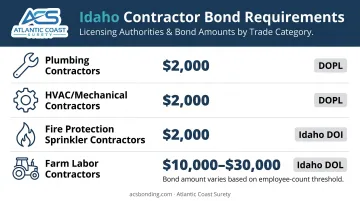
Verify current requirements at the Idaho Department of Labor's agricultural services page before applying, as these amounts can change.
Local and Municipal Requirements
State-level bonding is only part of the picture. Idaho cities and counties can — and do — layer on additional requirements. Two examples:
- Pocatello: Class A-1 contractors need a local license and permit bond at the required amount; Class B and sign contractors require bonds at a lower required amount
- Idaho Falls: Sign companies and public right-of-way contractors need bonds at amounts set by the local authority
Always check with the local building department or city procurement office before starting work in a new jurisdiction.
How Much Does an Idaho Contractor License Bond Cost?
Bond Amount vs. Bond Premium
These are not the same number. The bond amount is the face value — what the surety could pay out on a valid claim. The bond premium is what you actually pay to purchase the bond.
For an Idaho plumbing or HVAC contractor bond, you pay a premium — a fraction of the required bond amount — not the full face value out of pocket.
What Drives Your Premium Rate
NASBP notes that surety underwriting examines several factors:
- Credit history — the single biggest variable
- Financial strength and business stability
- Industry experience and management capacity
- Reputation and prior claims history
A contractor with strong credit qualifies for the lowest available rates. One with a thin or troubled credit history can still get bonded, though at a higher premium.
Working with Standard and Specialty Markets
For smaller license bonds, the annual premium is typically low, even for applicants with imperfect credit. Contractors who have faced credit challenges should work with a bond agency that accesses both standard and specialty surety markets — standard markets offer the most competitive rates, while specialty markets serve applicants who don't qualify there.
Atlantic Coast Surety is a bond-only agency with 20+ years of experience working with A-rated and T-listed providers across both segments. Because the firm operates as a wholesale broker, contractors submit applications through a licensed retail insurance agent or broker. Contact Atlantic Coast Surety at aspina@acsbonding.com or 201.661.2381 to request a referral.
How to Get an Idaho Contractor License Bond
Step 1 — Confirm Your Specific Bond Requirement
Before approaching any surety provider, identify:
- Which licensing board governs your trade (DOPL for plumbing/HVAC, Idaho DOI for fire sprinkler, Idaho Department of Labor for farm labor)
- The exact bond amount required
- Whether the board requires a specific bond form or obligee wording
- Whether the bond must accompany the initial application or can follow after exam passage
Each board publishes its requirements online — confirm the details directly before applying.
Step 2 — Apply Through a Surety Provider
The bond application typically requires:
- Business name, address, and contact information
- Year the business was established and state of incorporation
- Ownership information (all owners and their percentage)
- Authorization for a credit inquiry (standard for surety underwriting)
Smaller contractor license bonds typically move through underwriting faster than larger contract surety bonds. Working with an experienced wholesale surety broker — like Atlantic Coast Surety, accessible through your insurance agent — can streamline the process and open access to multiple carriers.
Step 3 — Submit the Bond to Your Licensing Board
Once issued, submit the bond and complete your licensing requirements:
- Submit to the appropriate authority — some boards accept electronic submissions, others require physical documents
- Keep a copy of the bond for your own records
- Display your license registration number on business materials, contracts, and job sites as required
Renewing and Maintaining Your Idaho Contractor License Bond
Bond maintenance requirements vary by license type:
- Plumbing and HVAC contractor licenses run on 3-year terms — ensure your bond remains active for the full license period
- Farm labor contractor licenses have their own renewal cycle through the Idaho Department of Labor
- Municipal bonds operate on the schedule set by each city or county
DOPL sends contractor registration renewal notices approximately six weeks before expiration. DOPL is also transitioning contractor registrations from 1-year to 2-year cycles beginning October 14, 2025 — update your calendar now if your renewal cycle spans this date.
Consequences of a Lapsed Bond
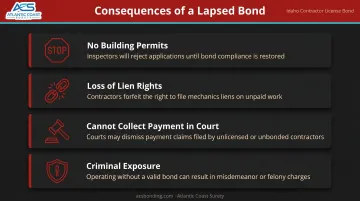
Letting your bond expire is not a minor administrative issue. Under Idaho law, operating without proper registration or bonding triggers real consequences:
- No building permits: Idaho Code 54-5209 requires authorities to verify contractor registration numbers before issuing permits
- Loss of lien rights: Idaho Code 54-5208 deems unregistered contractors to have waived their right to place a lien
- Cannot collect payment in court: Idaho Code 54-5217 bars unregistered contractors from bringing a court action to collect compensation
- Criminal exposure: Contractors who operate without registration face misdemeanor charges including fines and potential jail time under applicable law
When DOPL's six-week renewal notice arrives, act on it immediately — waiting until the expiration date leaves no buffer if your surety carrier needs additional documentation or underwriting review.
Frequently Asked Questions
How do contractor license bonds work in Idaho?
An Idaho contractor license bond is a three-party agreement where the surety guarantees the contractor will comply with state laws and fulfill licensing obligations. If a valid claim is filed and the surety pays, the contractor must reimburse the surety — so it functions as a performance guarantee, not protection for the contractor.
Which contractors need to be bonded in Idaho?
At the state level: plumbing contractors, HVAC/mechanical contractors, fire protection sprinkler contractors, and farm labor contractors. General contractors are not required to carry a state bond but should always verify local municipal requirements before working in a new city or county.
What types of bonds are required for Idaho contractors?
Most Idaho specialty trades require a license and permit bond at the state-required amount for plumbing, HVAC, and fire sprinkler contractors. Farm labor contractors require a larger bond based on employee count. Some municipalities require separate local license bonds beyond state requirements.
How long does it take to get an Idaho contractor license bond?
Small license bonds are often approved same-day or within 1–2 business days when standard underwriting applies. Larger or more complex bonds may take longer depending on the applicant's credit profile and the surety market involved.
Can I get an Idaho contractor license bond with bad credit?
Yes. Contractors with imperfect credit can typically still obtain a bond, though they will pay a higher premium rate. Working with an agency that has access to both standard and specialty surety markets, like Atlantic Coast Surety, increases the likelihood of finding a competitive option.
What happens if a claim is filed against my Idaho contractor license bond?
The surety investigates the claim and may pay the claimant up to the full bond amount. The contractor is then responsible for reimbursing the surety for any amount paid.